Distinguished Faculty Lecture Series: Asef Bayat, "Revolutions of Neoliberal Times"
Response by Rohini S. Singh

Wednesday, October 29, 2014

[On October 27, the Unit for Criticism & Interpretive Theory hosted the first lecture in the 2014-2015 Distinguished Faculty Lecture Series, "Revolutions of Neoliberal Times." The speaker was Asef Bayat, Bastian Professor in Global and Transnational Studies (Sociology). Professor Jessica Greenberg (Anthropology) responded. Below are reflections on the event from graduate student affiliate Rohini S. Singh (Communication).] 


"Tahrir Square Was a Revolution – Right?" 
Written by Rohini S. Singh 

People speak often of the "Arab uprising" and the domino series of revolutions it set off throughout the Middle East and North Africa in 2011. However, the key takeaway from Asef Bayat's talk on Monday was that we might not be correct in calling what happened in Egypt a revolution. Instead, argued Bayat, the people involved in the Arab Spring uprisings critiqued the impact of neoliberalism on their lives in ways which conformed ultimately to neoliberal logics. As such, these protesters did not effect meaningful change of the sort usually brought about by revolutions. Rather than unseat political regimes or overhaul economic systems, they merely voiced dissent without enacting tangible changes in existing power structures. 

This ineffectual behavior might seem counter-intuitive, said Bayat, especially in light of the increasing income inequality wrought by neoliberalism, the global economic phenomenon which places the principles of free market capitalism at the center of social and political life. After all, neoliberalism's espousal of capitalism has generated incredible exclusion and inequality. Bayat cited a Forbes survey which found that the 400 richest people possess as much wealth as half the American public and argued that this kind of inequality can be found everywhere in the world. However, in spite of this stark inequality, there seems to have been little challenge mounted against this system.

Bayat hypothesized that this is because neoliberalism generates dissent that is itself conditioned by the structures and logics of neoliberalism. Neoliberalism, explained Bayat, has commoditized emotions, relationships, and even social movements. It is a kind of governmentality that structures thinking and decision-making to the point where people cannot imagine a feasible alternative to it. By undertaking, as Michel Foucault called it, the "application of the economic grid to social phenomena," neoliberalism treats every institution as a business enterprise, whether it is a school, a hospital, or the state itself. It manifests in hierarchical structures, the constant striving for unlimited growth, the production of goods for exchange, fierce competition, the prioritization of self-interest, and the pursuit of efficiency. Hence, in its focus on individual effort and interest, neoliberalism seems to lack notions of society, community, the collective good, and real democracy (as opposed to formal democracy). 

Asef Bayat
In an effort, perhaps, to address this lacuna, two types of movements have arisen in response to neoliberalism. In places where neoliberal policies are mixed with autocratic regimes, we have seen revolutions aimed at regime change. However, in more liberal democracies, we have seen movements protesting the effects of neoliberalism while functioning within its structures. It is this latter group that we tend to see more in twenty-first century politics. Thus, the Occupy Wall Street movement in the U.S protested the involvement of money in politics as well as the effects of neoliberal projects (such as unemployment and inequality) without systematically or adequately questioning the capitalist system that lay at the root of this inequality. While the Occupy movement expressed a profound distrust of liberal democracy, the movement focused more on highlighting the crisis of political representation in the U.S. than on articulating a radical critique of liberal democracy or outlining the alternative system they wanted. 

Similarly, in Egypt, it was not the economic model but the political regime that was the early target of the revolutionaries. The irony is that despite being targeted, these regimes did not change. The revolutions of the “Arab Spring” were not revolutions in terms of effecting changes to the state led by the people. Instead, the protesters here sought a mix of revolution and reform: Bayat characterized these protests as “refolutions” or "revolutions without revolutionaries." These protagonists, he argued, had not read deeply about revolutions, unseating regimes, or questioning ideologies. They found themselves caught up in the revolutions of 2011, overtaken by events rather than instigating them consciously. Given that they had not had much experience with past revolutions, these protesters therefore had no idea how to wrest the state back from the power-holders in government. Thus, Bayat observed that the language of revolution in Egypt's most recent revolutions remained mild and innocuous compared to earlier revolutions because the newer revolutionaries lacked the intellectual resources and vision to transform the incumbent regime. The social and economic vision of leaders in the Arab Revolution differed little from that of the old regimes, in contrast to revolutionaries in Cuba, Russia, China, Nicaragua, and Eastern Europe, who advanced different ideologies from the regimes they sought to topple. 

Tahrir Square Protest, 2013
In addition, Egypt's protesters used the language of the markets to critique the political regime, thus resisting their governments while adhering to the principles of the capitalist system by which these regimes functioned. Bayat described how one of the revolutionary groups went so far as to use marketing techniques to “sell” the protests. In doing so, the Egyptian “revolutionaries” borrowed from the 1998 Serbian uprising which also used branding through street art as a way to promote their movement and its aims. As such, the Arab Spring revolutions remained fairly pro-business, both in their tactics and impact. Bayat noted that the Arab Uprising resulted in a minimal flight of capital or investment during the revolutions, with only eight factories taken over in Egypt versus hundreds in previous revolutions in Iran, Chile, Algeria, and Portugal. Bayat closed by noting that the unparalleled number of protests instigated during the Arab Uprising hardly translated into actual revolution or regime change. 

Jessica Greenberg's response asked what the clout of neoliberalism meant for the possibility of a coherent politics or effectual social movements. She argued that modern social movements have shown that if anything, we must abandon existing definitions of revolutions and question the value of revolutions as a means of social change. She suggested that we should shift our understanding from the definitional to the situational by focusing on the everyday lived experiences of people involved in revolutions. To that extent, she argued that for many activists, the important thing is not to ask what revolution means, but what it does. The lesson she drew from this was that the question is not what to do about neoliberalism, but how to live with it. 

The ensuing questions touched on the role of violence in revolutions and the fault-lines of neoliberalism. To the first, Bayat responded that revolutionaries in Egypt were adamant that they did not want to resort to violence in their protests, but that they did fight back when faced with physical intimidation by the regime. When thinking about the possible fault-lines of hegemonic neoliberalism, Bayat mused that neoliberalism's effects are seen in the unprecedented inequality it has generated around the world. Thus, in the dissents of the Arab world, the key issue was not just the dictatorial regime in power but the consequences of neoliberal ideology for the middle-class poor. Bayat urged the audience to realize the importance of engaging in the "long revolution" by seeking changes in laws and systems of power to push for lasting social transformation. 

[Bayat's talk was part of the Unit for Criticism's ongoing 2014-2015 Distinguished Faculty Lecture Series. The next lecture is on Monday, November 10, at 4pm, in the Alice Campbell Alumni Center Ballroom, where we will hear from Catherine Prendergast (English) on "Writer, Painter, Banker, Thief: The American Arts Colony in the Public Account."]
Read more
Caroline Levine, Letter from Wisconsin

Friday, March 4, 2011

posted under , , , , , , by Unit for Criticism

[In this post, Caroline Levine, professor of English at the University of Wisconsin-Madison, writes about the on-going demonstrations and rallies in Madison, Wisconsin.]

Three views from the ground in Madison
Written by Caroline Levine (University of Wisconsin-Madison)

I. Personal
Born in 1970, I and my classmates missed the sixties. My schoolteachers and college professors never tired of reminding us of this. They were frustrated with what they saw as our passivity and complacency. Why weren’t we more riled up? I loathed Reagan and George H W Bush, who presided over my coming of age, as much as the next left-leaning teenager. I certainly wanted change, as did many of my friends. And yet, the radical political groups I knew seemed powerless and puny in the face of huge forces that dwarfed their efforts—trickle-down economics, global capitalism, nonvoting minority groups, reactions against sixties cultural politics. I couldn’t imagine how you sparked a movement that mattered, and I was annoyed that our elders blamed us for being born too late, for feeling helpless and hopeless.

The last few weeks in Madison have changed me. They haven’t changed my deep feelings of helplessness—I still worry that worse times are around the corner, and that we can’t do much to forestall them—but now, for the first time, I understand the feelings of the generation that taught me. I’ve been to seven rallies since Valentine’s Day, each one bigger than the one before. The first one, a small group of graduate students and faculty, marched on the State Capitol—a ten- or fifteen-minute walk from the campus. At first we felt too embarrassed to chant, most of us, and chatted about the gloomy state of the state instead, as we walked disconsolately along the sidewalk.

When we got to the Capitol itself, the graduate students led us inside, and there something felt a little different. First of all, it seemed surprising that no one had stopped us, a thousand or so people, as we crammed through the revolving doors. Then the students’ chants echoed off the walls, filling the space, and we all joined together in the center of the domed building. An electricity seemed to unite the space. The Capitol, a neoclassical building that is usually hushed and populated by a few tourists and some hurried-looking legislative aides, felt vital in a way I’d never imagined. “Whose house?” we chanted. “Our house!” I have done some writing about large modern democracies, where people who share a government never meet. Usually I experience democracy as an abstraction, mediated in troubling ways by newspapers, television and the web. But in that moment the people seemed to become a dynamic and pulsing reality—and I felt, for the first time, like a part of a living body politic.

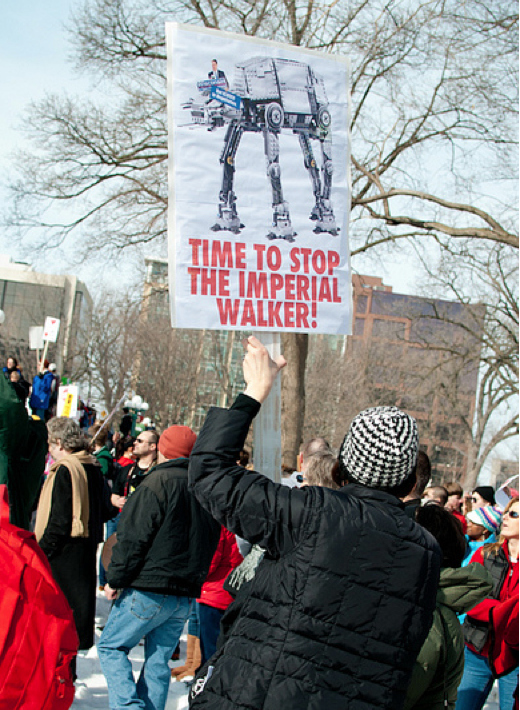
The next days brought bigger rallies. On Wednesday, on the steps of the Capitol, we were joined by union leaders, nurses, and a lot of undergraduates. On Thursday the sixteenth, Madison schoolteachers called in sick in such large numbers that schools had to close. Teachers from around the state poured in with signs. “Milwaukee math teacher teaching civics lesson today.” “If you can read this, thank a teacher.” “100% of teachers have more education that Scott Walker.”

We sent up a huge cheer as firefighters in full regalia—exempt from the Governor’s plan to end collective bargaining—joined us in a gesture of solidarity. Over the next few days, corrections officers and electricians and teachers and graduate students called each other “brothers and sisters.” They crafted sincere and witty and rousing and absurd signs: “Enjoy your weekend? Thank a union!” “I protect your family from the criminally insane.” “We’re just trying to have a society here.” “Do YOU plan on shoveling the roads?” “Scott, this relationship really isn’t working for me.” “There’s still good in you (Sky) Walker.” One of the most moving sights I have ever seen was the inside of the Capitol building looking like a carefully crafted work of collective art, its whole interior covered with lovingly hand-made signs.

There is always something slightly comic to me, an East Coaster, about mid-Western politeness, but the thorough absence of any threat of violence or even rudeness made huge crowds of chanting, marching, outraged radicals immensely fun. People brought their kids; cops passed out food and water to the protesters. Friends saw each other and stopped for lunch at a local Himalayan restaurant, only to return for more chanting and marching.

My seven-year-old son came along with me to a couple of the big rallies. He’s a dedicated fan of Harry Potter and Star Wars, and I was surprised to realize how much these have taught him about politics. Not just about good and evil, but about democratic processes: in Star Wars, the Jedi support an elected legislature against the encroachments of a greedy empire, and in Harry Potter Dolores Umbridge suspends established procedure—including freedom of speech and assembly—for the sake of her own authoritarian rule. My son really does understand the problem of power grabs, and he was more interested in the nitty-gritty of state politics than I’d expected. But it wasn’t just a civics lesson that I wanted for him. I had a powerful desire for him to feel that passionate, electrifying, peaceful oneness with a living crowd.

For the first time, then, I think I understand what motivated my teachers’ frustration with us, the non-protesting generation. It wasn’t just reproach at our inactivity: it was that we were missing out on a precious experience of solidarity we couldn’t grasp or imagine. They weren’t just disappointed in us, that is: they were disappointed for us.


II. Statistical
Of course, throughout the past few weeks, it has been impossible to forget that we protesters do not speak for the people as a whole, that folks who strongly disagree live alongside us in significant numbers. I have a bad habit of reading the comments sections after online news stories, and I have been astonished at the venom being spewed at lazy, greedy teachers (I didn’t even know that feeling was out there), the contempt for firefighters who allegedly retire to six-figure salaries after developing carpal tunnel syndrome (wait, aren’t they heroes?), and the assumption that it’s the corrupt unions who are bleeding the tax-payers dry.

I felt nervous when I went out for breakfast in a western suburb of Madison where people move when the city schools get too “diverse” for them (even progressive little Madison turns out to have white flight). My son was flashing his “Derail Walker” button, and I warned him that someone might yell at him, or at me, because they disagreed with us. He seemed unruffled—when the Force is with you, you’re not thrown by a little shouting—but I realized that I have a desperate desire for civil, productive, and rational public dialogue, and that in my lifetime that has seemed increasingly out of reach. I worry that protests don’t always help that ideal along, since they solidify a sense of us against them.

So call me naive, but I have also spent the past few weeks wondering how we might talk to those who disagree with us. For now, we’ve lost some major battles in the rhetorical war: the right has hammered away at their message so long and so consistently that the option of raising taxes on the wealthiest quartile is off the table completely. Walker gets away with the claim that only drastic cuts to education, health care, and environmental regulation can balance the state budget in these hard times. How could we intervene in that?

Part of the problem is, of course, money. The billionaire Koch brothers who poured millions of dollars into conservative coffers in this last election know that people are swayed by advertising—even though each of us thinks that we ourselves are immune. By putting their money into elections, the wealthy reap double rewards: more power than other citizens over electoral outcomes, and easy access and influence over the government that takes power. That’s why Common Cause, which works to keep money out of politics, seems to me to be one of the most important organizations out there. (In fact, I’m going to stop writing and send them a donation right now.) Unions, for all their problems, are one of the few organized interest groups in US politics that represent middle- and working-class people. Their financial contribution is minuscule compared to corporate donations, and they have dwindled terribly in size over the past few decades. But they are among the only counterweights to corporate power over government that we have. My brother, who runs the non-profit organization CIRCLE, has some wonderfully lucid arguments on this topic.

But if we had the floor and could speak loudly and publicly, what would we say? What arguments would work best?

I have been thinking, first of all, about how we might answer the opposing side with hard numbers. The state might be “broke,” as the Governor likes to say, but taxes in Wisconsin are regressive: families in Wisconsin making less than $20,000 a year pay 9.2% of their income in combined taxes, while families making $388,000 or more pay only 6.7% of their income in those taxes. We could also argue that trickle-down economics has not actually spurred our economy in the past thirty years, but instead has allowed economic inequalities to grow. We can always point out that despite budget problems in Wisconsin, the Republican-controlled Legislature approved $48 million in tax breaks in January 2011 for health savings accounts, which are tax havens for the top income earners (the average annual income of HSA participants was $139,000 in 2005). We can mention that there are over 100,000 millionaires in Wisconsin, and ask whether it seems fair that the poor and the middle class should make all the sacrifices.

III. Historical
For the far right—the Tea Partiers—these arguments wouldn’t make much of an impact. For them, economic equality takes a back seat to what they call “freedom.” It seems only right to them that people who earn money in a tough, competitive marketplace should be rewarded for their efforts, not penalized with taxes. In their view, unions are corrupt special interests who protect mediocre workers and fat benefits packages at the expense of the very struggling taxpayers who keep the economy going. Any regulation of business slows growth, they feel, and it’s just a reality that some people will be altogether left behind. Either they can compete with workers in the global South at sweatshop wages, or they can pull themselves up by their bootstraps. The new legislation proposed in Missouri to change child labor laws suggests that a return to the economic scene of the nineteenth century—where children provide cheap labor instead of requiring expensive schooling—might not be anathema to conservatives.

Now, I’m a nineteenth-century scholar by training, so I know something about what the world looks like under a booming free market society with comparatively little government regulation. Victorian England was something of a Tea Partier’s dream. But would conservatives really want to live there?

Consider the following. Smart industrialists in the nineteenth century were keen to hire the cheapest workers, and they found that children could operate most machinery just as well as adults for a fraction of the cost. Children as young as 4 or 5 could be expected to work a day that lasted 16 hours. Since there were no laws regulating workplace safety, it was common for workers, overcome with exhaustion, to fall over into the machines, their limbs crushed, their bodies mangled. Employers were not liable for these accidents. No worker was entitled to paid or unpaid leave of any kind, and new mothers usually found themselves having to return to factory jobs 2 or 3 days after giving birth.

Since there was no government regulation of food, vendors mixed grain with chalk and alcohol with turpentine. Canny purveyors of pepper mixed the genuine spice with dust swept from warehouse floors, and quite a lot of gin, on examination, was found to contain sulphuric acid. Patent medicines containing any mixture of herbs and minerals—including arsenic and morphine—were available without restriction. It was common practice among poorer mothers to give opium to babies to make sure that they would stay quiet all day while they worked. Countless infants died from overdoses.

If you were unlucky enough to become disabled, or lucky enough to grow old, you relied on the generosity of family members. Employers had no obligation to workers as they aged, and often left them to die on the streets after years of service. Those workers shrewd enough to invest their earnings for the future quite often found that they had been swindled, since proponents of the free market objected volubly to all government efforts to intervene in financial transactions, including fraud.

Without a public sanitation infrastructure in place, newly crowded cities saw repeated cholera and typhoid epidemics that swept away lives by the tens of thousands. The average urban life expectancy dropped. A boy born in Liverpool in the 1850s could look forward to seeing the ripe age of 26. Unable to rely on a public education system, Britain’s poorest families sent their children to work to cover the costs of keeping them. Half of England remained illiterate until late in the century, which meant that there was little way for the indigent to pull themselves out of poverty.

So devastating were these conditions that the public pressed Parliament to intervene. In 1833, the “Short Time Committees” succeeded in limiting the workday for children between the ages of 9 and 18 and abolishing labor altogether for those younger than 9; after mid-century the government started to regulate food quality and the sale of poisons; and by the 1870s the nation had begun to invest in compulsory public education and clean water.

These reforms were expensive. And in fact free market capitalists fought even the tiniest regulatory moves, predicting economic catastrophe. They also warned of moral decline, arguing that people would grow irresponsible as they acquired the habit of looking to the government for help.

Neither the moral nor the economic arguments have gone away. And now they’ve developed such force that the clock is turning eerily backward. Do we really want to go back to 1850? That question seems like an argument for knowing a little bit about history. And the answer would require investing in education, which apparently, for now, is off the table.

Read more

top