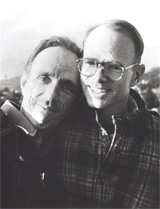
Tom Joslin and Mark Massi, Silverlake Life
[On April 30 and May 1, 2010, the Unit for Criticism partnered with the Holocaust, Genocide and Memory Studies initiative for a a conference, BIOS: Life, Death, Politics. In the first of a series of guest blogs from the conference, John Claborn writes about the panel featuring papers by Timothy Campbell (Cornell) and Cesare Casarino (U Minnesota).]
Campbell and Casarino on Tekhnē and Time-Images
Written by John Claborn (English)
In his anecdotal preface to the first panel of the Unit for Criticism’s co-organized conference, Bios: Life, Death, Politics, James Hay introduced panelists Timothy Campbell and Cesare Casarino as “Italianists” engaged with Foucault’s College de France lectures of the late 1970s and early 1980s. The presentations by Campbell and Casarino complemented each other well, as each began with an explication of biopolitics (drawing heavily on theorists like Walter Benjamin, Michel Foucault, Giorgio Agamben, Antonio Negri, and Roberto Esposito) followed by an attempt to theorize potential openings for resistance to modern biopolitical regimes.
Campbell’s paper, “‘Enough of a self’: Thanatos and the Tekhnē of Bios,” first offered a reading of Foucault’s concern with tekhnē in his work on the "Hermeneutics of the Self" and its relation to “modern modes of being subjects.” Foucault, Campbell interprets, advanced a “tragic reading of bios,” in which self-care as a modern mode of subjectivation constricts and captivates bios. Since Greek antiquity, tekhnē has separated from bios and now approaches it no longer as an object but as something to be mastered or “tested” within a “regime of the care of self.” Campbell then proposed a notion of “attention” as a possible mode of resistance to this constrictive regime, seeing attentiveness as a withholding of judgment and negation (i.e. the opposite of “testing”) from the object. A tekhnē of attention “reaches out” to the object not in order to test it, but rather to engage it in “creative play.”
Casarino advanced a notion of the “life-image” based on his reading of Gille Deleuze’s Cinema 2: the Time-Image as a “history” of time’s radical transformation under post-World War II biopolitical production (and reproduction) and post-Fordist capitalism. He showed a clip from the 1993 AIDS documentary Silverlake Life to illustrate the emergence of the life-image out of the “time-image.”
The time-image consists of shots that “express” duration rather than movement (of the camera or of figures in the mise-en-scéne). The documentary shows sequences of “cinematic still-lifes” (devoid of human presence) and various “whatever spaces” that express the alienation of the AIDS victim—the “walking dead,” as the voiceover says—from everyday, biopoliticized life. For Casarino, the life-image is not a representation of life but an “expression” of “enduring” life through the quasi-religious experience of the cinema.
In the discussion afterwards, the audience raised a few questions for Campbell: What is lost by removing “modernity” from the title of the talk (included on the conference schedule, but removed for the actual talk)? What exactly does Foucault mean by “test”? Does this concept need further elaboration and stronger historical grounding?
Some questions I have: how might this notion of “attention” benefit from an engagement with cognitive psychology and neuroscience? And does “attention” as resistance risk a kind of pure formalism reminiscent of Heideggerian authenticity? What is its political, ethical, and historical content?
Some questions for Casarino were also raised: How does the specificity of the video (vs. cinematic) medium in Silverlake Life affect the argument about the life-image? Can the life-image be thought of as emerging out of the “creative play” (tying into Campbell’s talk) of the time-image? What is the relation of the life-image to bare life?
Read more

 Priscilla Wald (Duke) opens the conference with her keynote address, "Human Being After Genocide: Cells, Genes, and Stories."
  Timothy Campbell (left) and Cesare Casarino (below) follow with a panel addressing Tekhne and the Life-Image, respectively.