MAD WORLD: “Leading with a Hand on the Hip: Michael Szalay’s Keynote Lecture”
Wednesday, March 10, 2010

 [The next in our series of posts from last month's symposium, MAD WORLD: Sex, Politics, Style and the 1960s, describes the morning keynote by Michael Szalay]
Written by David J. Roof (Education Policy Studies)
AMC’s Mad Men fosters a tension by encouraging its audience to think that they know the future unfolding before the characters. As Lauren Goodlad has written, “For some viewers, the secret of Mad Men's success is the pleasure of watching characters who don't know, as we do, that ‘change is gonna come.’" Where Hitchcock films famously lure us with a “MacGuffin,” in Mad Men the foreshadowing device is the complex historical terrain of the 1960s.
Patricia Arquette once said of David Lynch, “it’s another universe he takes you to–it’s an alternate reality but it’s close enough to our own that it’s scary.” Perhaps this captures another aspect of Mad Men’s allure. Dissolving the borders that separate fantasy from social reality produces uncanny effects. Michael Szalay’s keynote address at the Unit for Criticism’s February 19 Mad World symposium, “Mad Style: Market Segmentation and the Birth of Cool,” shed light on many such uncanny connections. Szalay’s thoughtful analysis uncovered a complex matrix of historical and social factors mediating the interplay between the fiction, advertising, politics, and race relations of the 1960s, and their representation in Mad Men.
Szalay’s stated aim was a flat reading of hip, or what Norman Mailer called “the formal aspects of hip.” For Szalay these involve a weaving together of the literary, political, and social contexts, including the transformations that occurred in Madison Avenue advertising between 1952 and1968, a period during which “hip” became a coded reference to African-American counterculture.
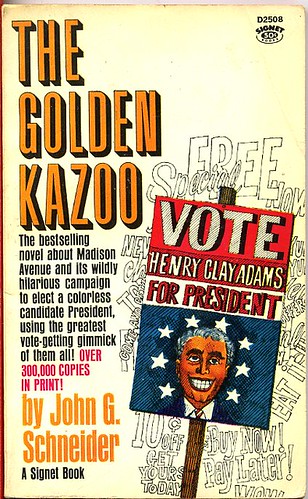 Szalay referenced John G. Schneider’s 1956 novel, The Golden Kazoo, to discuss the increasing reliance on advertising in political campaigns; the novel features slick Madison Avenue ad men predicting that the political candidates of the future will be merchandized like cans of beer or dog food. Szalay then turned to George Panetta’s Viva Madison Avenue! and Mailer’s The White Negro, both published in 1957. According to Szalay, Mailer’s work codified hip as a protest against Anglo-American culture. Both Panetta and Mailer represent a larger body of authors whose works attempt to reconcile white professionals to the presence of African Americans. In this way these postwar writers sought to establish an emulative connection to African-American counter culture.
The protocols of hip were established in "cool consultancies," which turned to black culture. Hip fetishized how blacks were presumed to live, thus revealing, according to Szalay, how the components of racial authenticity are always staged and open to reinvention. Hip functioned as a mode of irony in relation to the other. Participants in this cult of identification were allowed to pretend to be someone they were not, appearing as caricatures. That kind of performance also compels us to express ourselves through consumerism.
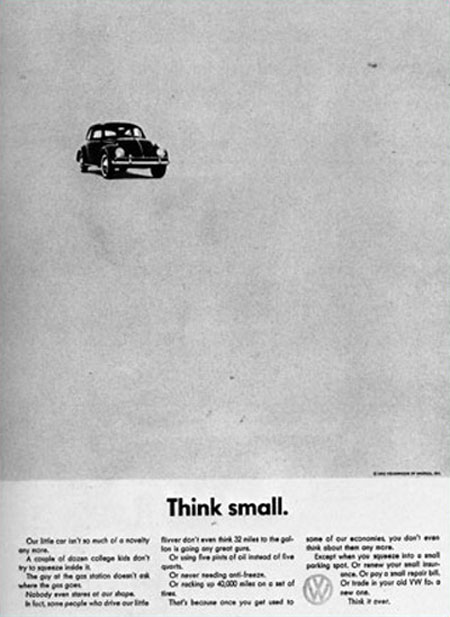 Advertisers needed to appeal to increasingly segmented groups without differentiating their products so much that production costs would exceed profit. Ad campaigns during this period thus became increasingly spectacular, having less to do with the commodity itself than a fantastical world into which consumers could insert themselves. One of the most emblematic was the campaign to market the Volkswagen, recuperating the brand from its Nazi-era association with the worst of white Anglo culture: technocracy, instrumentality, and mechanism.
 These shifts in advertising strategies, Szalay demonstrated, also had political ramifications. The characters in Panetta’s Viva Madison Avenue! maintain a romantic connection to the Democratic Party, as though it is a brand association. The importance of branding is exemplified in the pilot episode of Mad Men in which creative director Don Draper asks an African-American waiter about his loyalty to his brand of cigarettes . The man replies that he has simply remained loyal to the brand since they were given to him during the war. Szalay likened such loyalty to the New Deal-era loyalty to the Democratic Party which, by the late 1950s, was fading. During this period, advertisers and the Democratic Party faced the same dilemma: how could they appeal to the black market without alienating whites. In response, the Democratic Party and Madison Avenue realized the importance of utilizing codes to leverage a segmented electorate.
 Advertising allowed individuals to transcend the most policed barriers of American culture. Yet one of Szalay’s most provocative ideas was his reading Don Draper: not as a “white negro” or white man trying to pass for black, but as a figurative black man trying to pass for white—an idea that is illustrated by the credits sequence with which every episode of Mad Men begins.
Szalay also stressed that Mad Men shows us how class is translated into culture; issues of labor are transposed into attitudes and style. The signifiers with which we deeply identify play a role in the way we give meaning to the world, and advertising reorients these signifiers. As Don Draper states , “What you call love was invented by guys like me, to sell nylons.”


