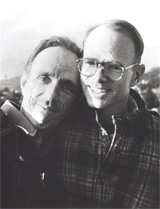
Faculty Lecture, Samantha Frost: “Body, Cause, Politics: The Beginnings of Biology for Humanists
Guest Writer: Brandon Jones

Wednesday, January 30, 2013

posted under , , , , , by Unit for Criticism
[On January 28, 2013 Samantha Frost (Political Science/Gender & Women’s Studies) gave the Unit for Criticism’s annual faculty lecture titled, "Body, Cause, Politics: The Beginnings of
Biology for Humanists.” Below is a response from Brandon Jones, a graduate student in English]

Biology as Criticism: Reimagining the Body as Biocultural Organism

Written by Brandon Jones (English)

Samantha Frost began her talk on her forthcoming book, Biology for Humanists, with an important disclaimer. This is no how-to-guide—no call for humanists to drop what they are doing to learn the intricate details of molecular and cellular physiology before they can even begin to talk about the body or biopolitics. Rather, she called our attention to the much bolder claim that she is trying to make with her title: biology is for humanists.

That is, for Frost, biology becomes another resource, not a trump card, for critical interpretations of embodiment. It is time to stop thinking about the principles of biological science as somehow outside of or opposed to the semiotic, social, historical, and political formations of subjectivity. Frost encourages us to question the dominance of some poststructuralist approaches to the body that historicize and denaturalize it, not in order to replace these approaches with claims of biological determinism, but to reimagine and reconfigure the body as both biopolitical subject and organism. Living bodies are both material and discursive—in a word, biocultural.

In her previous writings on Thomas Hobbes and New Materialism (her monograph, Lessons from a Materialist Thinker: Hobbesian Reflections on Ethics and Politics and her co-edited New Materialisms: Ontology, Agency, and Politics) we see Frost working up to this claim, moving away from social constructivist approaches to biopower and identity in favor of a closer attention to the material processes involved in bodily engagements with, and responses to, cultural and physical environments. In her talk, Frost drew upon her experience in the biology classroom as an Andrew W. Mellon Foundation New Directions Fellow to give us explicit examples of how attention to biology (particularly the molecular and cellular variety) can help humanists reimagine insightful critical orientations to the body.

By starting with the claim that biology is indeed for humanists, Frost emphasized that a primary objective of her forthcoming project is to disrupt suspicious modes of thinking about biology. She wants to dispel the fears humanists have toward biology as a discipline outside of the humanistic fold, as a set of incontrovertible truth-claims that seek to define our embodied destiny. We do not have to consider biology solely as a discipline that takes the body to be a natural rather than cultural object of knowledge.

Frost made this point by noting how humanist approaches that examine the body as biopolitical subject enact a reversal of the logic of biological determinism. Whereas naturalistic accounts of the organism point to the self-evident material attributes of biological structure and function out of which bodily and cultural formations arise, the poststructuralistic critique of this alleged essentialism holds that discursive regimes of epistemological and political power are behind this building of bodily identities. But according to Frost this reversal recapitulates the logic of biology as destiny, which naturally follows when we consider the idea of the body as organism as somehow insidious. The fear is that if we foreground the biochemical processes of the organism, we may be falling prey to a political ruse; we may miss the manner in which our sexual and racial identities, for example, are being manipulated by forces of biopower. How are we to avoid this bind while taking biology seriously?

Frost offered her methodology of reimagining and refiguring biological selfhood by way of answer. She did not argue for replacing humanist practices of historicizing the body with principles of biology, but rather advocated a shift in emphasis toward examining the material processes by which organisms engage with their social and physical environments to maintain their constitutions as living entities. We do not have to pick one side of the nature versus nurture debate, but can change the conversation by dispelling notions of causality that describe the relations between biology and culture as linear and unidirectional.

Frost illustrated the theoretical difficulty humanists may have in getting to this point by sharing a debate she had with a student regarding the question of whether we can definitively say an organism is alive or dead. She posed the scenario of coming across a dead squirrel. We would both agree, she said to the student, that the squirrel was indeed dead, correct? The student responded by saying yes, we would, but then invoked arguments of social and historical relativism to claim that they could only come to that agreement given a certain shared cultural environment and biological episteme. Frost insisted on the simple but crucial point that, in the end, the student can tell the difference between a dead squirrel and a live squirrel. While the student insisted that that was not the point--could we not imagine a culture that mistook the squirrel’s deadness for liveness--Frost emphasized that our being able to tell was precisely the point.

Without suggesting that humanists discard their critical heritage, Frost encouraged them to overcome the difficulty in saying that embodied beings are definitively alive (or dead, as the case may be). Living bodies grow within habitats, and these habitats, as domains of subsistence, are materially substantial as well as social and symbolic. The manner in which we are embodied and embedded in habitats is not reducible to sociality or physicality; instead, nonlinear, complex relations between material and discursive processes form, de-form, and re-form an organism’s biological and environmental conditions that allow for an embodied livelihood.

Again, Frost made it clear that by emphasizing this point she is not trying to establish a new foundation for humanist approaches to biopolitics and bioethics. She is not calling for tackling the intimidating obscurity of biochemical details of anatomy and physiology; she is calling humanists to question the perception of biology as obscure and politically problematic. The majority of humanists working on sociopolitical issues of embodiment, Frost claimed, continue to envision the movements, flows, and trajectories of cellular and molecular processes as yet unimaginable and unknowable for their projects. To refigure the common critical perception of biology in the humanities in order to think of living bodies as biocultural organisms, Frost argues, can only aid in attending to the complex ways in which we respond to and shape our socio-material subjectivity and environment.

To demonstrate how such a reimaging of biology can enhance the critical questions humanists can ask, Frost closed her talk by turning to three features of molecular and cellular biology concerned with material boundaries. The first is the principle of entropy, the role of which is as crucial to molecular processes as it is to physical thermodynamics and informational systems theory.

Frost gave the example of two atoms moving closer to one another. These atoms vibrate as they approach, and upon encountering one another constrain each other’s vibrancy. This results in a state that is collectively higher in energy, a condition highly disagreeable to physical entities. In order to lower the energy of the compound state, the atoms have two options: (1) they can bond in a chemical reaction to form a molecule, which results in energy dissipation, or (2) they can mutually repel one another, which also leads to energy dissipation. In either case, the dissipation of energy amounts to an overall increase in disorder: the law of entropy states that, as a result of their tendency to decrease energy levels, atoms and molecules will reach the most disordered state they can in a given context.

The second feature Frost touched on was the semipermeability of cellular walls, or membranes. Her point here was to emphasize that cell walls are neither indiscriminately porous, nor are they hermetically sealed. Instead, they are selectively permeable such that certain molecules (lipids, proteins, etc.) may pass in and out via diffusion in order to maintain homeostasis. For molecules that are too large to simply pass through the membrane, there are specialized channels (such as the protein channel in the cell membrane diagram) through which they can enter the cell. Thus, cell walls do not function to mark a sharp distinction between intracellular and extracellular, but to allow diffusion across the boundary.

The final feature she touched on was the interaction of these porous cell bodies. Cells do not relate to one another as rigid, discrete structures but as squishy, mutable blobs that selectively exchange materials across their membranes. Although Frost did not explicitly elaborate on how these molecular and cellular processes come to bear on core issues of politics and ethics, her implications were clear: the dynamic flows and relations of biological processes challenge conceptions of boundaries as arbiters of discrete spaces of interiority and exteriority. They do not necessarily have to mark spaces of violent encounters between self and other, but can allow for selective openness between entities and environments.

Her bottom line: biology for humanists (and Biology for Humanists) can help provide ways to understand nature with culture, and biology with politics.
Read more

Timothy Campbell
"A Common Milieu: Italian Thought After 1968 and 1989"

Sunday, September 5, 2010

posted under , , , , , , by Unit for Criticism

A Common Milieu: Italian Thought After 1968 and 1989
Written by Timothy Campbell (Cornell University)

[Guest writer Timothy Campbell was a speaker at the Unit for Criticism's Spring 2010 conference, BIOS: Life, Death, Politics. His below "manifesto" on Italian thought is written in conjunction with Cornell University's upcoming September 24-25 conference, Commonalities: Theorizing the Common in Italian Thought. It also anticipates Roberto Esposito's October 2-5 visit to the University of Illinois as the Unit's first Nicholson Distinguished Visiting Scholar.]

For the better part of a decade the position of Italian thought in the Anglo-American academy has increasingly grown in importance. From issues as far ranging as bioethics and bioengineering, to euthanasia, to globalization, to theorizing gender, to the war on terror, works originating in Italy have played a significant, perhaps even the dominant, role in setting the terms and conditions of these debates. Indeed it might well be that no contemporary thought more than Italian enjoys greater success today in the United States. If twenty years of postmodernism and poststructuralism were in large measure the result of French exports to the United States—Derrida, Lacan, Deleuze, and Foucault—today a number of Italian philosophical exports are giving rise to a theoretical dispositif that goes under a variety of names: post-Marxist, posthuman, or most often biopolitical. Yet the fact that Italian thought enjoys such enormous success in the United States and elsewhere begs an important question, one put to me polemically recently by a prominent Italian philosopher. Is there really such a thing as contemporary Italian thought? And if there is what in the world do its proponents have in common?

By way of responding, it might be useful to recall some details about the recent reception of Italian thought in the American academy. In the aftermath of the end of the postmodern—which a number of American observers savored as spelling the end of the use and abuse of philosophy by large numbers of literary critics—two works appeared in English within a span of three years: Giorgio Agamben's Homo Sacer and Michael Hardt and Antonio Negri's Empire. Stepping into the void left by the departure of what in the United States was known as "theory," these works made a number of bold theoretical claims about the relation between political power and individual life (Agamben) and globalization and collective life (Hardt and Negri), claims that uncannily—sometimes almost prophetically—addressed some of the most pressing issues in our current state of affairs. Equally a number of important works of Italian feminism appeared over roughly the same period. Works by Adriana Cavarero and Rosi Braidotti, among others, deeply influenced a whole generation of American theorists in fields like gender studies, political philosophy, and law. Looking back it's difficult to overestimate the influence of all these figures when accounting for the intellectual success of Italian thought today. Certainly it became possible for other voices to be heard, Paolo Virno, and more recently Franco Berardi, Roberto Esposito, and Maurizio Lazzarato among others.

But to take up again the question at hand: what do authors as seemingly different as Agamben and Negri, Berardi and Esposito, Braidotti and Bodei, or Cavarero and Virno have in common outside of the mere fact of writing in Italian? Beyond a common language, is there, for example, such a thing as a common Italian philosophical tradition of which they are all a part? Some, most notably, Mario Perniola, would say yes, one found in the elements of repetition, transmission, mixture, and body that together forged an Italian philosophical culture over the last 300 years. Deleuze and Guattari would have said no, arguing that Italy has historically "lacked a milieu" for philosophy. For them the reason for this lack could be found in Italy's proximity to the Holy See, which continually aborted philosophy across the peninsula, reducing Italian thought to mere rhetoric, philosophy's shadow, and allowing only for the occasional "comet" to briefly light up the philosophical sky.

Yet what if Italian thought today does in fact enjoy a milieu? What "event" or "events" in the recent past might have fashioned a milieu for the emergence of Italian thought? What would the features of that milieu look like?

Undoubtedly, the decade-long Italian 1968 would have played the decisive role. The votes on abortion, the emergence of counterculture and student and feminist movements, and changes in labor and production all deeply changed the space in which politics—as well as philosophy—was practiced. Indeed one of the central features of the Italian 1968 was precisely the emphasis on politics as philosophy and philosophy as a form (among others) of politics. We can see this in the place 1968 and 1977 awarded political militancy; in the increasing prominence given to questions of subjectivization; and more broadly in the birth of new forms of social and political life separated from those that had previously dominated.

Yet Italy’s long 1968 wasn't enough on its own. It was only with 1989 and the fall of the Berlin Wall that politics and philosophy truly begin to pass intensely into each other, to stay with the language of Deleuze and Guattari. Although it may seem less the case for those writing in Italy, when seen from the outside 1989 was experienced as trauma more in Italy than in the rest of Europe. The result forced a number of thinkers to re-examine the fundamental political and philosophical categories that had underpinned decades if not centuries of thought: what meaning would the end of a certain form of common life have for politics, for philosophy, for culture? Such a calling into question of the previous understanding of the common had the effect of reterritorializing politics and philosophy under new terms and new problematics, one of which will be “life,” broadly speaking. It is only when 1968 is considered as the motor for deterritorialization of the common in political theory and philosophy and 1989 as the turn toward its reterritorialization as newly mapped by (among other things) biopolitical theory that something like a milieu is constructed for contemporary Italian thought.

This is not to say that proponents of Italian thought share the same understanding of the common or even celebrate it. Clearly they do not. Yet the centrality of the common raises a number of questions about Italian thought and Italian public life today. What does it mean to be or have in common in 2010? What are the effects of questioning the weight of shared life and what possible futures are there for the common? How might singularities be thought together so as to create new forms of life and what kinds of co-habitations or contaminations might reinforce these new forms of life? These kinds of questions are ones Italian thought, in all its diversity, has placed at the forefront of contemporary theory, questions that in turn raise fundamental questions about the nature of relationality and of a politics that would seek to strengthen relations and to extend them in order to create yet further relationality. Such is the force of Hardt and Negri’s discussion of the capacity for love near the end of Commonwealth, though one can well imagine others, including a capacity for play, for attention, and for compassion too.

Yet the relationality implicit in these new forms of shared life doesn't only lead to greater and more positive capacities for relationality among singularities. The deterritorialization of the common as biopolitics, the posthuman or even insurrection by no means conjures away the specter of power; thus with greater capacity on the one hand comes the possibility of more intense and invasive forms of power on the other. The question then becomes: how are new forms of the common that are being forged today—shared singularities, mirror neurons, impersonality—also being reterritorialized and recontained, and by whom? Is it possible that more intense forms of relationality might signal a return to the very terms that earlier critiques of the common had attempted to uncover? On the one hand the recent success of social networking sites like facebook suggests that new forms of virtual relations involving vast numbers of "friends" are not only possible but involve ever greater exposure to others. On the other hand such exchanges continue to be premised on the notion that my body and my opinions belong to me, what the Invisible Committee unforgetably characterized as treating "our Self like a boring box office," using whatever prosthesis is at hand "to hold onto an I." In such a neo-liberal scenario, the circulation of information, of goods, of persons, of persons as goods is taken to mean a return to a common mode of being-together. It's a film we've seen countless times before: the common's reinscription in contexts less open to affect that are continually based upon a conflation of connnectivity with more open modes of relating.

These questions among others will be the foundation for a two-day conference sponsored by the journal diacritics to be held on the campus of Cornell University on September 24-25, 2010. The conference, titled "Commonalities: Theorizing the Common in Italian Thought," will bring together a number of Italian voices so as to think together not only the relation between Italy and the common but to consider emerging forms of the common and common life today as well as consider the efficacy of a term like the common for a progressive (bio)politics. Equally, the event, the first of its kind of recent memory in the United States, is an occasion to register the state of Italian thought today. When seen from the other side of the Atlantic, no other contemporary thought more than Italian seems better suited today to offer what Foucault called an ontology of the present. At a minimum, and pace my doubting Italian philosopher, the editorial and intellectual success of Italian thought merits a closer look.

Featured at the conference will be some of the leading philosophical figures from Italy today, including Franco Berardi, Remo Bodei, Cesare Casarino, Ida Dominijanni, Roberto Esposito, Michael Hardt, and Antonio Negri. The conference will be transmitted over the internet at http://www.commonconf.com. A number of Cornell students will be blogging the conference live over the two days.


Read more

BIOS: Life, Death, Politics; "On Criminals, Enemies, and Enemy Combatants": Paul Kahn's Keynote Lecture

Thursday, May 6, 2010

posted under , , , , , , by Unit for Criticism
Left: Guards lead a detainee at Guantanamo Bay Naval Base

[In our continuing coverage of the 4/30-5/1 conference, BIOS: Life, Death, Politics, Michael Verderame writes on the afternoon keynote lecture by Paul Kahn (Yale Law)]

Written by Michael Verderame (English)

Paul Kahn’s keynote address focused on two categories often opposed to one another in legal and political thought—the enemy and the criminal. The crucial distinction between the two categories, for Kahn, lies in their relationship to the circle of social concern. Enemies exist outside the boundaries of society, and therefore the state can legitimately exercise violence, even lethal violence, against them. Criminals, on the other hand, despite their transgressions, retain membership in the social order, and the state is restricted in what modes of punishment it can properly exercise.

The preservation of the enemy/criminal distinction, Kahn argued, is crucial to the political imaginary underlying the modern liberal, paternalist state; the presence or absence of “love,” in his words, is what enables societies to tell the difference between criminals (deserving of punishment but still members of the social “family”) and enemies. The most egregious instances of torture and abuse of civil liberties arise when the distinction is collapsed or blurred, as in the case of treason against the state or the War on Terror’s new enemy/criminal hybrid category, the “unlawful combatant.”

Kahn’s intriguing and eclectic talk ranged from American Revolutionary War history to the constitution of the European Union (which, in its hypertechnicality, Kahn sees an attempt to eliminate the sovereign while retaining the rule of law) to contemporary films such as The Matrix, Taken, and Inglourious Basterds. The common thread in Kahn’s historical narrative is the use of violence, and the “sacrificial history” of wounded, maimed, and dead bodies, to symbolically reconstitute the law. This link was made explicit in Abraham Lincoln’s speech commemorating veterans of the Revolutionary War, in which Lincoln described veterans’ bodies as literally embodying a “religion of law.”

In the lively discussion following Professor Kahn’s talk, several people asked about the conspicuous absence of race in his narrative about the construction of enemies and criminals, and indeed at times Kahn did seem close to endorsing a narrative of progress that covers up racial difference. Kahn repeatedly situated his remarks in the context of the wars in Afghanistan and Iraq, but another contemporary political context sprang immediately to mind for me: the current hostility towards undocumented immigrants, culminating in repressive legislation in Arizona. Undocumented immigrants, like “enemy combatants,” trouble the distinction the state attempts to preserve between criminals and enemies. Marked as racially and ethnically other, they are defined both as “criminals” (for being present in the country illegally) and, increasingly as “enemies”—a foreign presence, almost an invading army, that threatens to transform the cultural character of the polity and is therefore undeserving of the due process protections normally afforded to criminal defendants.

I wonder how this increasing figuration of undocumented immigrants as “enemies” can be assimilated into Kahn’s narrative, which seems to paint the narrative of American history as over time broadening, not restricting, the scope of social concern.

It seems to me that the relationship between criminals and enemies has become increasingly porous in other ways in the last few decades. The creation of a homeland security apparatus, complete with color-coded terror alerts, explicitly militarizes the domestic political body in new ways. For the last few decades it’s been common to speak of America’s inner cities as “war zones” and for major cities’ police departments increasingly to adopt military tactics and procedures. Political responses to the September 11, 2001 attacks (sometimes coded as criminal and other times as acts of war) also highlighted the instability of these categories.

John Walker Lindh, the “American Taliban,” provides an especially intriguing test case for Kahn’s theory of parental love as underlying the distinction between criminals and enemies. The uncertain legal status of the prosecution of the white, upper-middle-class, quintessentially “American” youth who chose to take up arms with the Taliban, became a Rohrschach test of the limits of liberal paternalism. Was Lindh a “criminal,” who had violated his country’s laws but remained within its sphere of concern, or was he an “enemy,” who had aligned himself against the United States and forfeited his membership in the polity?

In the end, Professor Kahn steered clear of making normative judgments about the categories of criminal and enemy, instead charting the beginnings of a genealogy of how these concepts have functioned in our juridico-political imagination. But I wonder if it possible to envision a state which classified neither criminals nor enemies, or must both categories be classified in order to constitute a state in the first place?
Read more

BIOS: Life, Death, Politics; Campbell and Casarino on Tekhnē and Time-Images
Guest Writer: John Claborn

Sunday, May 2, 2010


Tom Joslin and Mark Massi, Silverlake Life


[On April 30 and May 1, 2010, the Unit for Criticism partnered with the Holocaust, Genocide and Memory Studies initiative for a a conference, BIOS: Life, Death, Politics. In the first of a series of guest blogs from the conference, John Claborn writes about the panel featuring papers by Timothy Campbell (Cornell) and Cesare Casarino (U Minnesota).]

Campbell and Casarino on Tekhnē and Time-Images


Written by John Claborn (English)

In his anecdotal preface to the first panel of the Unit for Criticism’s co-organized conference, Bios: Life, Death, Politics, James Hay introduced panelists Timothy Campbell and Cesare Casarino as “Italianists” engaged with Foucault’s College de France lectures of the late 1970s and early 1980s. The presentations by Campbell and Casarino complemented each other well, as each began with an explication of biopolitics (drawing heavily on theorists like Walter Benjamin, Michel Foucault, Giorgio Agamben, Antonio Negri, and Roberto Esposito) followed by an attempt to theorize potential openings for resistance to modern biopolitical regimes.


Campbell’s paper, “‘Enough of a self’: Thanatos and the Tekhnē of Bios,” first offered a reading of Foucault’s concern with tekhnē in his work on the "Hermeneutics of the Self" and its relation to “modern modes of being subjects.” Foucault, Campbell interprets, advanced a “tragic reading of bios,” in which self-care as a modern mode of subjectivation constricts and captivates bios. Since Greek antiquity, tekhnē has separated from bios and now approaches it no longer as an object but as something to be mastered or “tested” within a “regime of the care of self.” Campbell then proposed a notion of “attention” as a possible mode of resistance to this constrictive regime, seeing attentiveness as a withholding of judgment and negation (i.e. the opposite of “testing”) from the object. A tekhnē of attention “reaches out” to the object not in order to test it, but rather to engage it in “creative play.”

Casarino advanced a notion of the “life-image” based on his reading of Gille Deleuze’s Cinema 2: the Time-Image as a “history” of time’s radical transformation under post-World War II biopolitical production (and reproduction) and post-Fordist capitalism. He showed a clip from the 1993 AIDS documentary Silverlake Life to illustrate the emergence of the life-image out of the “time-image.”

The time-image consists of shots that “express” duration rather than movement (of the camera or of figures in the mise-en-scéne). The documentary shows sequences of “cinematic still-lifes” (devoid of human presence) and various “whatever spaces” that express the alienation of the AIDS victim—the “walking dead,” as the voiceover says—from everyday, biopoliticized life. For Casarino, the life-image is not a representation of life but an “expression” of “enduring” life through the quasi-religious experience of the cinema.

In the discussion afterwards, the audience raised a few questions for Campbell: What is lost by removing “modernity” from the title of the talk (included on the conference schedule, but removed for the actual talk)? What exactly does Foucault mean by “test”? Does this concept need further elaboration and stronger historical grounding?

Some questions I have: how might this notion of “attention” benefit from an engagement with cognitive psychology and neuroscience? And does “attention” as resistance risk a kind of pure formalism reminiscent of Heideggerian authenticity? What is its political, ethical, and historical content?

Some questions for Casarino were also raised: How does the specificity of the video (vs. cinematic) medium in Silverlake Life affect the argument about the life-image? Can the life-image be thought of as emerging out of the “creative play” (tying into Campbell’s talk) of the time-image? What is the relation of the life-image to bare life?

Read more

Etienne Balibar: "'Biopolitics': The New Behemoth?"
Guest Writer: Denys Van Renen

Thursday, October 15, 2009

posted under , , , , by Unit for Criticism


From top: Etienne Balibar lectures on Biopolitics, and Marcus Keller introduces Balibar

A large crowd at the Levis faculty center welcomed Etienne Balibar to the University of Illinois last night (Oct. 13) for his first visit to the Urbana-Champaign campus. After a warm introduction given by Marcus Keller, Assistant Professor of French & Comparative Literature and a former student of his, Balibar began his talk, “Biopolitics: The New Behemoth?” (a reference to the Book of Job and the “twin allegories” of the Leviathan and the Behemoth) by foregrounding the “impolitical side of the world order.” In the first half of his lecture, he discussed Michael Hardt and Antonio Negri’s Multitude: War and Democracy in the Age of Empire (2004), focusing on their formulation of a “global civil war” (a war of all against all that has taken the place of the Cold War, which pitted nation-states against one another). While admiring their trilogy, he alighted on their discussion of the enemy as “evil,” an abstract conception that necessitates perpetual war in the name of “security,” as well as the creation of a specific type, having “foreign” traits (retaining traces of Carl Schmitt’s friend/enemy distinction) Instead, he developed the concept of the “stranger.”

Put forward by the Polish sociologist Zygmunt Bauman (“There are friends and enemies. There are also strangers.”) the idea of the stranger provokes questions such as “Who are they?”; “For whom are they strange?”; and “Where do they come from?” because while some strangers can be assimilated within a nation-state, others do not enjoy the rights of citizenship in their adopted country. They also introduce intranational borders and change static perceptions of national borders. Balibar builds on Bauman to ask for whom the border is symbolic (those who can pass and repass) and for whom it is dissimilar (those who cannot be readmitted).

Another central concept Balibar discussed was “translation.” He stressed the need to go beyond traditional practices of translation, which tend to reinforce the cultural practices of the dominant group. In other words, those who translate tend to fit the other group’s words into their culturally-specific idiom or context. In Balibar’s view, we should do more to understand each other’s habitus and idioms, creating a transnational public space. This new form of translation would protect strangeness and diversity. As I understood his formulation, borders, which drive productive exchanges between peoples of different cultures, can work constructively. In this way, individuals might have more control over borders as they promote cross-cultural communication on a personal and local level. By contrast, totally dissolving them (as when NGOs, among other entities, imagine a world without borders) allows policing institutions to make abstract a pervasive enemy, perhaps advancing repressive practices in the name of security.
Read more

top