10/24 Christopher Newfield, "The Innovation Conspiracy: Ruin and Rebirth in the American University"
Guest Writer: Robert Mejia

Thursday, October 27, 2011

[On Monday, October 24, the Unit for Criticism hosted “The Innovation Conspiracy: Ruin and Rebirth in The American University,” a lecture by Christopher Newfield, professor of English at the University of California at Santa Barbara. The below contribution is from Robert Mejia. The event was the third and final celebrating the Unit for Criticism’s thirtieth anniversary.]

Christopher Newfield’s "The Innovation Conspiracy: Ruin and Rebirth in the American University"
Written By Robert Mejia (Institute for Communications Research)


Though familiarity may make our walks across the quad appear to be regular and mundane, we must remember that the discourses involved in sustaining a campus like the University of Illinois are anything but. I can recall my first experience of the quad, looking over it from the Illini Union Hotel and thinking, "here is a real college." Even though the space is hardly free from the excluding effects of class and race, the relatively free flow of bodies and the spontaneous interactions that emerge as a result is symbolic of the democratic promise of a public university. And so it was fitting that Christopher Newfield described his own morning walk through the quad when he began his October 24 lecture, "The Innovation Conspiracy: Ruin and Rebirth in The American University"—the last of the Unit for Criticism’s three 30th birthday celebratory events.

Those of us familiar with the campus know that the quad is often a crowded walkway fraught with various charitable and not-so-charitable organizations vying for our attention, or at least spare change. In this regard, the quad again functions as a physical manifestation of the state's disinvestment from the University. As Newfield noted, though public investment in education has declined since the 1960s, enrollment at research institutions like the University of Illinois and the University of California has quadrupled over that same period.

Public divestment from higher education poses an ongoing threat to the ability of public universities to uphold the promise of a democratic society. However fraught the promise may be, the public university system is a more accessible site for intellectual development and the maturation of social responsibility than private alternatives. Public research universities, for instance, reach over twice the number of students as private research universities and at only half the cost per student. If we are to continue to believe that public access to education is the cornerstone of a democratic society, then public interests cannot be left to private entities.

And yet, this is precisely what is happening. Universities, according to Newfield, are caught within the "death spiral" of an "innovation conspiracy." The conspiracy does not indict innovation itself, but rather the pretense that innovation is antithetical to collective modes of existence and vice versa—particularly the assumption that bureaucratic institutions like government and the research university resist innovation. Newfield's ideas on the individualist character of innovation are modeled on the legacy of Joseph Schumpeter. He notes that even though universities invest millions of dollars in innovation—wired and wireless campuses, for example—the notion that innovation must be foisted on them by outside entrepreneurial forces persists.

The key steps of Newfield's "cycle of decline" show how loss of public funding leads to privately funded initiatives that, while often good in themselves, do not serve the core educational mission—even though the result of sustaining them is typically increased tuition. As the public finds itself paying more for less, the result is a new cycle of public defunding.

To elaborate just one point in the cycle, universities raise tuition for multiple reasons one of which was the subject of Newfield's 2009 article in the journal Profession. The scenario Newfield describes is one in which universities lack the support to cover the overhead of grants. At the University of California, for example, the difference between net research funds and the total costs of research is a gap of 720 million dollars. (Grant recipients who hand over money for overheads to the university do not always realize that these overheads are insufficient to cover costs.) These uncovered costs must be covered from state funds or, failing that, student fees and tuition. This occurs at the same time that state funding is declining and private fundraising cannot be used for core operations. The examples of rising tuition Newfield cited showed increase of as much as 400% in the last two decades, compared to 250% for healthcare costs.

Though the solution is complex, Newfield suggested that a good starting point is transparency. Budget transparency is a crucial part of the picture, but it is not the only one. Another goal is to rearticulate education as a public good—an idea Newfield believes enjoys public support despite the increasing privatization of public education through high tuition and, thus, decreased access. In a less predictable light, Newfield urges teachers to make educational labor (their own and that of their students’) more transparent. This includes teaching as well as research. As Newfield drew a picture of pedagogy as a kind of professional craft, using the example of his own teaching and advice in a teaching abroad program, I was reminded again of the Illinois campus. At various spots along the engineering and main quads, placards can be found documenting the social contribution made from individuals and/or departments, such as Wilbur Schramm’s contribution to the establishment of NPR and PBS, or John Bardeen’s contribution to the invention of the transistor. These placards, as we know, are not enough.

How does one enact Newfield’s recommendation that we make our pedagogical practices visible? He argues that this can begin with the simple practice of documenting the learning process that transpires within the community of a public university. In the teaching abroad program in France, Newfield asked each student a question to help him or her formulate a research goal. Most students, he reported, had never been asked to describe the kind of research that might appeal to them—much less to create a research project springing out of these interests. When students are encouraged to think of themselves as scholars, and not as students taking one more step toward their ticket to a profession, the potential for making the collective gains of education visible becomes apparent. Teaching (and research) should be practiced as a form of education labor guided by a craft ethos. The benefits of education can be articulated beyond the acquisition of career credentials: as laying the foundations for a more democratic society.
Read more

15 Ways to Take Your Furlough/Voluntary Pay Cut #14a
Ratemyadministrators.com

Sunday, April 11, 2010


[The latest additions to the Unit for Criticism's "15 Ways to Take Your Furlough/Voluntary Paycut" series on higher education are by Zsuzsa Gille, associate professor of sociology, writing on university administration from the perspective of neoliberalism, and James Treat, associate professor of religion, waxing lyrical (below)]

"Ratemyadministrators.com or, Finding a point of intervention in the neoliberal catch-22"


Written by Zsuzsa Gille (Sociology)

As we continue expressing our critique of how the University of Illinois deals with its fiscal crisis, it is important to see this moment as part of a longer and larger project. I am no expert in educational policies; I am a sociologist who studies globalization and neoliberalism, and it is that vantage point which I recommend for our consideration.

There are two key parts to the neoliberal agenda which have been implemented in U.S. public education. Both are self-generating, so I will call them vicious circle #1 and #2.

Vicious circle #1: The making of the irrelevant faculty class.

We have seen an intensificaton and acceleration of what Mario Tronti calls the withdrawal of capital from the class relationship.

Since the late 1980s a rapidly increasing portion of profit has come to derive not from actual production of useful commodities but from speculative ventures like the credit devices responsible for the current global financial crisis. In a similar move, our university has also started to seek out non-productive sources of profit, such as real estate development and the idea of hosting private corporations in its research park.

New technologies make possible the fast turnover of global finance capital as well as the “deskilling” of labor, so that employees in any given firm become more easily replaceable. In academia, we have seen the spread of “labor-saving” technologies, such as online (scantron-like) assessments, digital libraries, and PowerPoint presentations. I myself have embraced some of these technologies because they saved time I could dedicate to research.

But since these technologies enable the further growth of class size, they quickly transition from a “how-to” technique for saving time, to a “have-to” device for coping with an expanded workload. Increasingly their tendency is to justify a view of teaching as simply the operation of technologies: the plugging-in of existing digital and online platforms, templates and data-bases. The Global Campus initiative was the logical outcome of these technologies, which would have employed select faculty to develop standardized courses that anyone with some college education could then use—that is, sell—anywhere and at any time. Under current social conditions, online education of the kind now pursued by the College of Liberal Arts and Sciences, for example, ends up, no matter how noble its intentions, making faculty labor ever more irrelevant for the generation of academic revenues.


Vicious circle #2: Neoliberalism as cause and as solution to the present crisis.

The other trend has been the intentional under-development and de-funding of the public sector, resulting in colossal disasters, human tragedy, and economic crisis, to which, ironically, further privatization then becomes the only logical solution.

Think of Hurricane Katrina, the gravity of which was exacerbated by reduction of public funding for the maintenance of levees and emergency services. Think of the collapsed bridges, roads, and electric grids in different parts of the country resulting from the underfunding of public infrastructure. And think of the recent fiscal crisis, which in part resulted from of the dismantling of the regulatory apparatus for Wall Street.

While many academics conclude from these debacles that the public sector needs more funding, Republicans, and too often Democrats as well, conclude that it is best to give up on the public sector altogether and either eliminate or contract out an increasing number of state services and duties. Through this ingenious trick, the neoliberal reforms that cause these crises also become the solution to it. The University of Illinois’ current economic problems have been caused by public de-funding, but also by the channeling of dwindling funds to private entrepreneurial projects and to administrators who earn ever higher salaries. Although expanding administration, privatization and entrepreneurialism have demonstrably caused financial problems—like the creation of Global Campus–we are now expected to seek out more of the same to redress our crisis.

One way in which our administrators have gone about realizing this dubious agenda is by implementing an increasing set of quantitative measures aimed to discipline faculty labor. I believe it was in the 1990s that administrators started demanding that departments increase their rankings on a series of indexes, such as the students/FTE or majors/FTE ratios.

More recently, they started measuring not only departmental but also individual faculty performance, not by the quality of that faculty member’s teaching or research, but by the money the university spends on student per faculty. Such assessment calculates the “worth” of a faculty member by measuring his/her cost-effectiveness in producing instructional units. While public access to this data is partial at best, my own observations suggest that actual scoring has little effect on either the number of lines given to a department or a faculty member’s salary. Ironically, then, these metrics, while yielding a desired disciplinary effect, do not make the university’s economic foundation any sounder—even by the dubious calculus defines sound economy as the efficient production of instructional units.

What these metrics did was to legitimate administrative decisions by a) making them look scientific, and b) making low-performing units and faculty accept the view of themselves as unworthy—further eroding their ability to mobilize against inequality, attacks on academic freedom, and other grievances. These indexes also pit departments against departments, schools against schools, thus preventing faculty solidarity from developing.

Where does that leave us in terms of our tasks? While I think we must work at different scales, from federal through state to local—and the Campus Faculty Association is certainly doing the latter two, while AAUP is active at the federal level as well—one so-far neglected entry-point into both vicious circles I identified above is that of our lower-level administration: provosts, associate provosts, college deans, associate deans, and, yes, even department heads.

I recommend that faculty get together (perhaps on some future furlough day?) to create a webpage and scoring device on the analogy of the popular student website, ratemyprofessors.com. With too few exceptions, administrators at these levels have not only devised and imposed the above-mentioned metrics but have also used them to attest to their marketability in the ever more lucrative academic administrator job market. How many administrators have we lost just in the last three years who after wreaking havoc in several units were catapulted into even higher positions at other colleges exactly because they could boast such “success”?

If we created an alternative set of indices for administrators we could provide not only a more balanced evaluation of their performance but also turn the Panopticon back on them: let them fear us as much as they fear the people who appointed them. Let us then share their scoring with students, their parents, and the electorate. This is one way in which we can stop collaborating in their agenda of making faculty labor ever more irrelevant.

What are the metrics we should use for evaluating our mid-level administrations? How about the number of low-income students admitted, retained, and/or funded; the number of faculty positions created and retained? How about evaluating their effectiveness in keeping a high ratio of faculty to students or of keeping administrative salaries comparable to those of faculty?

No doubt, we need more creativity here. And here’s the cream of this pudding: while we are engaging in this creative politics we are also building solidarity and, dare I say, class culture without which, according to E.P. Thompson, there is no class politics, and certainly no viable faculty union.
Read more

15 Ways to Take Your Furlough/Voluntary Pay Cut #13
"Beyond the F-word"

Wednesday, March 31, 2010

posted under , , , by Unit for Criticism

[In the next in our "15 Ways to Take Your Furlough/Voluntary Pay Cut" series, the head of the UIUC English Department considers the budget crisis from departmental and campus perspectives.]

"Beyond the F-word"
Written by Curtis Perry (Head, English Department)


I have read the previous installments in this series with considerable admiration and have found many of my own concerns about the nature of academic labor and the future of public education reflected in much of what my colleagues (here and at other universities) have had to say. At the same time, I am also becoming aware that my own experience of this year's budget-related strife has been very different than that of most of my colleagues as a result of my administrative roles on campus: I am head of the English Department here, and have served on committees at both the college and campus level charged with advising on responses to the budget crisis since early Fall.

Perhaps because I have sometimes had the feeling of being in the loop, I have not had the same profound experience of alienation and disempowerment that many of my colleagues associate with the sudden imposition of furloughs in January. In the long run, I feel certain that the faculty activism spurred by these feelings will be one overwhelmingly positive result of our present crisis. One hopes that recent campus activism in support of public higher education here and elsewhere is part of a sustainable national movement. In the short term, though, I worry that animosity towards university and campus administration may lead people to wash their hands of budget-review processes just now taking shape that have to be informed by the perspectives of engaged faculty members.

Process, you say?

Decisions about the budget are now being reached in two semi-distinct ways. First, individual colleges are being asked to review their operations and to reduce their budgets, with targets that (my understanding is) will vary according to dependence upon state funding (as opposed to tuition revenue or gift money or overhead from grants). Presumably this will happen in different ways in different colleges—I have been part of an advisory committee made up of various department heads and associate deans charged with advising on a process in Liberal Arts and Sciences, but I have no idea what is happening, say, in the College of Engineering.

Second, a central steering committee is managing a series of review teams charged with the investigation of things that are either funded centrally on our campus or that deal with potential duplications of effort across colleges. With one exception (the review team charged with looking at IT) these teams have been charged with gathering information and reviewing effectiveness and efficiency rather than with recommending any specific amount of cuts. One team might say that massive cuts are called for, while another might say that the things they have looked at are working perfectly. There will be more of these, and you may be asked to serve on one of them. I serve on a committee that has an advisory role in this central process, and it seems to me that the stated principles and criteria have in fact guided the deliberations and choices that have been made at the campus level so far.

These two processes are related—in that savings identified via the central review process will have an impact upon the need for college-based cuts—but each raises different communication challenges and involves faculty in different ways. If you read through the review team charge letters online, you will probably feel that some are important to you and that others are not. But in each case, it is incumbent upon the team itself to seek out adequate input from faculty and/or other relevant, informed, interested parties. Cuts at the college level are more likely to impact faculty work conditions and academic programs, and so it is correspondingly more important for deans to find ways to seek out faculty input in order to make sure that efficiency measures adequately account for what is important to the needs of teaching and scholarly innovation.

In speaking to my colleagues of late, I have had the sense that anxiety about potential cuts at the college level has led to animosity that is aimed primarily at the campus and university system leadership. And, for the record, I do have questions about the amount of administrative overhead that the university system seems to require, such that English as a department is in the red despite the fact that our classes raise approximately $6 million more a year in tuition revenue for the system than our operation costs to run. This disparity has something to do with the fact that revenue needs to be spread around in order to support the broad spectrum of activities characteristic of a great, comprehensive research university. But that's only part of the story. And the gap between what we provide and what is provided for us is where questions about spending really hit home for a department like ours. Nevertheless, I do feel that we as a campus cannot expect to be immune from the economic crisis affecting the state and the whole university system, and that it is therefore incumbent upon all of us (departments, colleges, etc.) to take seriously the need to spend what money we have as wisely as possible.

For faculty—at least for those making enough to be able to absorb the pay cut—outrage over the furlough program has to do with concerns about the perceived nature of academic labor and about the felt need to protect and extend faculty governance in an era that seems likely to be about retrenchment. I share these concerns. But I feel some cognitive dissonance, too, as I hear angry calls for increased budget transparency from colleagues in one ear while attending endless meetings in which various administrative bodies (made up mostly of faculty) attempt to figure out how to get more faculty to become more involved in decision making.

At the college level, this has meant the recent establishment of a new faculty advisory group to supplement the department heads group that I'm part of, and an array of various meetings that the dean holds with different faculty groups. At the campus level, this has been harder to manage centrally since each review team has a very different set of interested parties to consult (though I can tell you that email suggestions through the website are read, have been discussed, and may in some cases lead to new review projects). In any event, though, the question being asked now in the meetings I attend is 'how can we inform the faculty and solicit valuable suggestions' rather than 'how can we keep this process under wraps.' And there are things here at the University of Illinois that are in fact more programmatically transparent than any other university I'm aware of—anyone, for instance, can access a huge amount of budgetary and operational information about all departments and colleges on this campus online anytime at http://www.dmi.illinois.edu/cp/. That's where the numbers behind my calculation of tuition revenue come from, and anyone can use this site to track budgetary data for departments, colleges, and the campus over the last decade.

In my view, the biggest challenge for faculty and administrators seeking transparency on this campus has to do not with administrative malfeasance or creeping corporatization but with a deep structural tension arising from the need for central leadership on budgetary matters within a university culture that has hitherto been unusually decentralized in nature. All kinds of important things seem never to have been tracked very well here, and growth (per DMI, for instance, there are about 1000 more APs on campus now than there were in 2000-01) seems in many cases to have taken place on an ad hoc basis in response to local initiatives without a clear sense of overall impact.

I don't necessarily think that decentralization is a bad thing, either. APs may have been added to the payroll without careful attention to overall budgetary impact, but the administrative labor performed by APs frees up faculty research time. And in general a decentralized mode of governance can be wonderfully creative and responsive precisely because it leaves operational decisions in the hands of the people doing the work. But when central leadership is required (and I do think it is required now) this culture of local governance creates a built-in transparency problem because it is hard for anyone making centralized decisions to feel as though they are acting on good enough information. Nobody I speak to wants to see budget cuts applied evenly across the board, but how can you spread cuts across an institution more strategically if you can't find sound bases for comparisons between departments and colleges, don't have a comprehensive sense of what everyone does, and can't quite pin down what happens with all the dollars in the first place?

This semester's furloughs were part of a hastily implemented plan to meet an anticipated shortfall for the current fiscal year. They were part of the same planning effort involving the Fall rescission (whose impact on faculty may be greater than the furloughs, at least in my department, since we had no cash reserves and are now in the red). If these things seemed clumsily executed—across the board rather than strategic—that had to do partly with haste and partly with the problem of decision-making in a culture where operational wisdom is decentralized.

My understanding is that the campus will now be forced to make some significant permanent cuts for FY 2011. Unless they are imposed by the state against the will of university administration, I do not anticipate more furloughs. Nobody likes them, including administrators, and there is time to plan better. But I do anticipate a year of wrangling over cuts, and I think everyone I work with at any level of college and campus administration would agree that the results of this will be best if faculty and others with a stake in our research and teaching mission are willing to weigh in and ask questions and provide arguments.

There may be low-hanging fruit—central administrative growth that can be scaled back without pushing costs into colleges and departments, operational things we don't really need to be doing—but beyond that the budget review process, boiled down to some kind of essential structure, has to involve this: generate fiscal data and look for inefficiencies, seek out the operational causes of those inefficiencies, and then decide if there is a sufficiently compelling pedagogical or scholarly value to the way things have been done that warrants the extra cost in each case.

Getting a better picture of what we now have on the ground has meant, and will continue to mean, asking questions about budgetary efficiency in research and teaching areas. This is especially true, I think, for the review process now underway at the college level. This will understandably raise red-flags about corporatization. But surely the corporatization that we fear has to involve more than just being aware of the economic bottom line: it has to involve making decisions based on fiscal efficiency without caring adequately about educational and research goals.

To me, the test of the whole process will have to do with the nature of the discussion surrounding the last stage, and it will be essential that faculty and other people involved primarily in the teaching and research that we do be given a fair hearing and opportunity to participate in decision-making when the time comes to weigh pedagogical and scholarly values against the imperatives of cost. I'm pretty sure that the various advisory committees I serve on will not be able to represent the faculty adequately in this, since we all have only limited knowledge of areas outside of our own. So it will be incumbent upon review teams and college administrators alike to make sure that there is real, informed consultation along the way.

My own paranoid vision about the corporatization of the university has to do not with administrative duplicity but with the pervasiveness, in budget-planning meetings, of the business-world maxim that crisis is opportunity. Now, the argument goes, we have a chance to reposition ourselves and to become, in the process, a stronger institution, one that will in the long run be better off than we would have been without the budget crisis and its fallout. As is probably clear from what I've already said, I do think that there are aspects of the operation here that can be improved, so in the weakest sense I guess I do feel that the self-scrutiny provoked by our current crisis may have some long-term positive results.

But I do not trust the crisis-is-opportunity mentality, with its implicit pre-supposition that the way we have been doing things in departments needs correcting, and I am deeply suspicious of an organizational climate in which the new and seemingly-efficient is too likely to seem preferable to the tried and true. No matter how humane and enlightened the process is by which we make cuts, I think things will be lost that are of real educational and scholarly value. And like many of my colleagues, I am worried—not optimistic—about the future of graduate education in the humanities and about the ideal of access to affordable public education.

It will take the intelligence and imagination of committed faculty members to ensure that educational and research goals are being given adequate weight when the time comes for permanent cuts, not because I think our campus leadership is wicked but because without feedback from concerned faculty members they won't know enough to weigh things appropriately. So, yes: organize, critique, resist. But also: show up for campus budget meetings, ask your deans questions, read the documents posted on the campus's budget-review website, use that site to ask questions about them, participate in departmental administration, accept appointments on review teams, and be ready to argue pragmatically with real people for the importance of the things here that matter most to you.

Read more

Visions for the Future of the University of Illinois
Feisal Mohamed, "Of Learning and Labor"

Saturday, March 27, 2010

posted under , , , , by Unit for Criticism


[On March 11, the Unit for Criticism and the IPRH hosted a panel on "Visions for the Future of the University of Illinois" featuring presentations by Hadi Esfahani, Peter Fritzsche, Feisal Mohamed, Lisa Rosenthal, Alexander Scheeline, and Ruth Watkins. Below are excerpts from Professor Mohamed's contribution.]

Of Learning and Labor

Written by Feisal Mohamed (English)

[The author wishes to acknowledge the assistance of university archivists Bryan Whitledge and Linda Stahnke, as well as of Winton U. Solberg’s University of Illinois 1867-1894: An Intellectual and Cultural History (U of Illinois P, 1968).]

Most universities, we all know, display mottoes that are nonsense cloaked in Latin. Not so for the University of Illinois, which is graced with a motto, "Learning and Labor," that on the surface at least seems admirably clear. And yet in these times of ours the relationship between its two substantives seems muddied, even contentious.

We see the signs of that contention in recent labor actions by the service workers and graduate students, and in the sometimes comic confusion surrounding the implementation of furloughs, which are an affront to both learning and labor: they add injury to injury by docking the pay of employees who have already had their wages frozen, and they imply that the pursuit of knowledge is a form of punch-clock drudgery, thus depriving it of an ethical impulse.

The motto itself holds its share of ambiguity. Why the gerund "learning," as opposed to what we might expect, "knowledge/scientia" or "truth/veritas"? Does "learning" have less than nounal substance, suggesting the priority of labor? Or is it meant to imply that learning is processual, ever-developing, while labor is a static fact of life? Or is there simply an affinity for alliterated l’s in this Land of Lincoln?

When close reading yields more questions than answers, we turn to the archives, where we will find that the original seal of the Illinois Industrial College held the motto "Onward and Upward" in a ring containing the words "Farmers and Mechanics."

That the university seal is no longer graced by that sentiment is owing in no small measure to the priorities of our first regent, the pleasingly named John Milton Gregory, who carried with him from his own training in classics at New Jersey’s Union College a sense that the age called for education both liberal and practical. Liberal education alone, he recognized, might do well for Princeton, but did not suit the needs of mid-nineteenth-century central Illinois.

Many on the Board of Trustees favored a more stridently utilitarian curriculum. Appearing in a series of epigraphs to the board’s first report is a passage from Emerson that may reflect their interpretation of the new motto: "he only is a sincere learner, he only can become a master, who learns the secrets of labor." Alarmed by such decadences as the appointment of faculty with expertise in literature and history, one of the trustees, Matthias L. Dunlap, used his regular column on agriculture in the Chicago Tribune, which he wrote under the pen name "Rural," to air his disputes with the regent’s proposed curriculum, branding it as "antagonistic to the spirit and letter" of the Morrill Act, and declaring that "this school... was specially designed to improve the industrial classes, to educate them to better manage their several avocations, and not to cultivate a few in the highest branches of knowledge."

Gregory responded to such objections exactly 142 years ago today, on the March 11, 1868 official inauguration of the university, where he made a case for the golden mean between liberal and practical education first in verse by way of the university anthem that he wrote for the occasion—"Learning and Labor—fit head for fit hand— / Shall crown with twin glories our broad prairie land"—and next in prose, in an address availing itself of the age’s wonderfully inflated style. (I will quote this highly enjoyable speech at some length, though I have expurgated some of the language of its time; no one here, I trust, will see it as the university’s mission to train manly fiber, raise a noble race, and the like.)

The hungry eyes of toiling millions are turned, with mingled hope and fear, upon us, to see what new and better solution we can possibly offer the great problems on which their well-being and destiny depend.... But it is not merely the voice of our fellow citizens which has called us to this work. The Age itself, invites us.... ‘tis labor lifting its Ajax cry for light to guide its toil, and illuminate its life.... Shall we simply teach the sciences without attempting to teach their practical applications, then we fall again into the error of the old schoolmen. Our science will be bookish learning. We [will] have failed to forge the golden fetter which binds learning to labor. The industries will look in vain for skilled leaders from among our graduates. Shall we neglect all of science except its results[?]... What is this more than the old apprenticeship? For science thus learned neither educates nor enlightens. Its possession would be an evanescent dream, and its influence a mere passing shadow.... Prove that education, in its highest form, will “pay” and you have made for it the market of the world. The light which has heretofore fallen through occasional rifts, and on scattered hill tops, will henceforward flood field and valley with the splendors of the noontime sun.


This rousing effort would lead an embarrassed Dunlap publicly to extend his hand in capitulation, and to mollify his tone in his later Tribune columns on industrial education.

In our own moment, neoliberal ideas of higher education cast an eye as skeptical as Rural’s on the less than practical disciplines, claiming the market as the best setter of curricula. The recent economic collapse has exposed the benevolent market as a cruel fiction, and the employment crisis that ripples in its wake suggests especially that an education founded on skills alone will have fleeting value in the unstable years ahead. Twenty-somethings will have to be prepared not only with skills, which are likely rapidly to become obsolete, but with the willingness and capacity to be lifelong learners.

Even the Rurals of the world must concede, then, that knowledge is more than an elitist brand of recreation. Indeed, Columbia economist and Nobel laureate Edmund Phelps argues in the January issue of the Harvard Business Review that it is the past decade’s lack of support for innovation that has created an economy lacking dynamism and has damaged "long-term value creation." An active mind is valuable not only in and of itself, but as a vital, perhaps essential, resource in the tumultuous world that today’s undergraduates will have to navigate.

With our double mission in view, I would like tentatively to offer a few practical proposals:

1) That we show a commitment to the learning of all citizens, renewing our efforts in such initiatives as the Odyssey Project, as well as dusting off the machinery of the Global Campus and applying it to free non-credit online courses, along the lines of the Open Yale project. We must model the belief that higher education is a right rather than a privilege if we want others to believe that it is so.

2) Make public our own dissatisfaction with our bloated tuition rates, and with the state divestment from higher education that deprives too many of opportunity. Loudly and frequently we must declare that stable and sufficient funding of higher education is fundamental to quality of life in this state.

3) Shed those elements of the institution that serve no purpose toward our core mission. The poor Aviation School has received unwelcome attention in this kind of conversation, but why not also look to the example of Emory University and scrap costly Division I NCAA Athletics programs; and

4) Take a firm stand against the shrinking of the tenure stream, and sustain our commitment to world-class research. Students attending public universities have as much right as anyone to be taught by faculty who are at the forefront of their fields, and to do so in classroom settings congenial to interaction. I am sure that we all remember from our days as students those times when we were taught by a true master of the discipline, a rich experience made even richer if it is in a seminar rather than a lecture room of 200.

To return to the language of our first regent, the time demands as much as ever that we strike the golden fetter between learning and labor. Though decorum prevents me just now from raising an Ajax cry to guide that toil, I will say that we might like Aeneas carry on our shoulders the patrimony of Gregory’s effort out of a noble city that, with the best of intentions, has admitted within its walls the Trojan Horse of corporatization, and strive toward a future truly brilliant in flooding every field and valley with both knowledge and opportunity.


Read more

15 Ways to Take Your Furlough/Voluntary Pay Cut #12
"Teach Your Children Well"

Monday, March 22, 2010

posted under , , , , by Unit for Criticism

[In the next in our "15 Ways to Take Your Furlough/Voluntary Pay Cut" series, Kate Clancy, assistant professor in Anthropology, considers work in higher education from the perspective of parenting.]

"Teach Your Children Well"

Written by Kate Clancy (Anthropology)


My husband and I are both assistant professors and scientists. We both have laboratories, mentor a large number of students, and need to be in the office all the time. We have a beautiful daughter who is about to turn two, and have Monday through Friday full time daycare. In addition to the forty-five hours of work we get out of childcare, we trade off on Sundays (I work mornings, he works afternoons) and we work most nights once our daughter is asleep.

Our lives aren’t that flexible. We work all the time. Despite this, I am quite happy with my job – I feel free to pursue any research I find interesting; I teach bright students who, for the most part, are willing and eager to go along with all of my wacky ideas about active, democratic learning. I feel well supported by colleagues in my department, and in organizing for the Campus Faculty Association I have met a whole new set of wonderful peers and mentors across the university.

Recently a writer for a local website for mothers interviewed me, wanting my take on the furloughs. When the writer and I spoke by phone, I learned the angle she wanted the story to take: she saw the furlough as an opportunity any mom would jump at, as a way to spend more time with her kids. She wanted to know what my daughter and I would be doing together.

Did I miss the part where I could (and would) furlough my day care provider? Because we all know we don’t get that money back. Listen, I love my daughter and I have dropped every hobby I once had so I could maximize my time with her. But what are we teaching our kids if a furlough day turns into a field trip? I don’t want to teach my daughter that when my employer docks my pay despite excellent performance, that I should paste on a smile and head to the zoo (or worse, that I should work invisibly and without pay). That means I am taking my furlough in a way that maximizes, not minimizes impact. I am not going to be another working parent whose work life balance is invisible or disingenuous.

There is something I want both my daughter and my colleagues to learn, and that is to fight. This job encourages passivity. We all feel so lucky, after years of apprenticeship, to be one of those select few to have “made it” to the Holy Grail tenure-line job. We wonder how we got here, whether we are impostors after all, whether our colleagues will find out about us in classroom observations, grant proposals, or our tenure review. Before the relative privilege of a tenure-track faculty position comes years of huge risk with no promise of a financially or professionally secure life. And so we wait for the next moment, the next year, the next promotion, to speak up or stand up. We decide, in our offices, eating our lunches at our desks alone, that we’re doing okay and can just ride this crisis out. We forget that operating in isolation, while comfortable, is not actually scholarly. In an age of interdisciplinary scholarship, staying out of this mess will produce lower quality work than building relationships with colleagues and facing it.

I want my daughter to be a giant pain in the ass. I want her to know her worth. I want to teach her that when you stand up for yourself and get involved in local issues, that the effects on your psyche are permanent and that the effects on your local environment are long-ranging and long-lasting. My daughter watches my face for every emotion; she imitates my behavior and gauges my reaction to the world around us. If I slink away and take my pay cut and hide in my darkened office working on my furlough days, my daughter will learn passivity. If I stick around, get my colleagues to join the union, if I pass on these stories to her the way my dad passed on his about working with Vietnamese refugees, or the times my mother told me about how she stood up to her parents’ racism, I will be providing examples of what it means to stand up in conditions of uncertainty and risk. And I will show her it is possible to be relaxed while defying forces of injustice, and that even if they do their worst, everything will have been all right. I am a better scholar, mentor, teacher and parent when I help to make this fight public.

TA lines and contingent faculty are being cut despite their enormously important contributions to this campus; department budgets are slashed; student fees are on the rise; and I have a feeling tuition waivers for employees’ kids will be gone soon too. But this job and this life, the idea of a university that provides stable jobs and a quality education for the people of Illinois, for this, we must make time.

We have two of a total of four common furlough days left. On February 15th we met for a teach-in and on March 4th we joined campuses all over the country in solidarity. On the next common furlough day, April 6th, we will meet to organize this campus, and on April 21st to storm Springfield. So, two more days when I will not work, two more days that my daughter will be in childcare, two more days I will devote to the work we need to do to restructure this university.

The zoo will wait, though my heart aches to say it, because this fight helps to secure a good life for my daughter. This is the story I will pass on to her one day, because this is the life I want to model for her.
Read more

Visions for the Future of the University of Illinois
Peter Fritzsche, "Beyond Mismanagement"

Thursday, March 18, 2010

posted under , , by Unit for Criticism

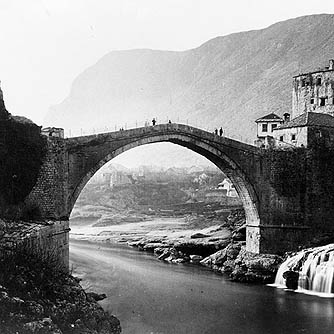
On the left is a photograph of the Old Bridge in Mostar, Bosnia and Herzegovina

[On March 11, the Unit for Criticism and the IPRH hosted a panel on "Visions for the Future of the University of Illinois" featuring presentations by Hadi Esfahani, Peter Fritzsche, Feisal Mohamed, Lisa Rosenthal, Alexander Scheeline, and Ruth Watkins. Below are excerpts from Professor Fritzsche's contribution.]

Written by Peter Fritzsche (History)

My perspective is from the core campus and the humanities. It is important to underscore that the resources are here, the quality of faculty and research is unimpeachable, but these resources have been mismanaged so that the remarkable enthusiasm for Illinois and at Illinois nurtured in the 1990s is in jeopardy. There is obviously a huge money problem, but there is also a problem of what I think of as “readership” that hampers “leadership,”

The mismanagement has come in the form of a lack of recognition of core campus strengths. Overall, the humanities and social sciences are not recognized on this campus; the books and arguments of the faculty are not profiled and their role in the production of new knowledge is not widely understood by recent campus administrators.

The campus has huge resources in international studies, in the area studies centers, in our Title VI investments. These strengths add up to nationally and internationally recognized excellence which is woefully neglected by the campus, imperiling future federal investments.

The humanities and social sciences, which often play with big ideas about the origins of violence, the nature of belief, and the ramifications of genre can help the university make its arguments about excellence. It is extraordinary that these fields are not mobilized to represent the university in a more sustained manner—especially as we make our case to the state during a time of budgetary shortfalls.

There are not sufficient resources available to sustain grass-roots faculty initiatives. The Research Board is great and I am delighted that its funding has not been cut. This is the single most important program and it is a great credit to the University of Illinois not simply to fund the Research Board but to reap the benefits of the research it supports. However, at this point, after being “taxed,” many departments have no money to partner with faculty to provide intellectual programming for our students and colleagues. No ability to invite disciplinary visitors and maintain disciplinary academic programming. Cross-disciplinary initiatives are so underfunded so that only particular top-down initiatives can be put on. IPRH and the Unit for Criticism lack the funding to link up with faculty ideas that trickle up. This jeopardizes the academic environment at the University. Both units need more adequate resources to sustain more grass-roots programming.

Faculty excellence in teaching and research is not sufficiently rewarded through the low-cost expansion of teaching awards and teaching releases. Moreover, the cost of recognizing and showcasing faculty accomplishments on websites, university publicity, and university presentations of itself comes at no cost whatsoever, but failure to do so sends a dispiriting message to the humanities and social sciences.

The crucial transmission of knowledge to our students is imperiled by a drive toward economies of scale so that the time-tested model of teaching assistant sections in large lower-division courses–the model in history since the 1890s
is being de-legitimated by ill-considered initiatives in distance learning and by cost-cutting efforts to replace TAs with graders.

Recognition of excellence and research capacities are mocked by strange top-down initiatives such as Stewarding Excellence at Illinois which has all the signs of being completely tone-deaf to what really happens on campus, and the persistent drumbeat of IT and digital humanities as the next big thing. It is not. Recognition of excellence is also mocked by the cronyism that marred the chancellor’s office until this fall. And finally recognition of excellence is mocked by a fascination with what we don’t do and a disregard for what we do do, indeed by an actual disdain for “strength,” which, from my vantage point, characterized the provost’s office until recently.

What do the humanities do? They critically evaluate the cornerstones of the ways in which we understand the world. Why were people slaughtering each other in Yugoslavia less than twenty years ago? Was it economic hardship, religious feuds, memories of violence and victimization? Were the reasons contingent or structural, sticky or elastic? The answers to these questions were pertinent to the conduct of American foreign policy, which initially wrote off the violence as ancient and thus intractable.

The humanities evaluate just this sort of proposition through local ethnography and historical research and discourse and symbolic analysis. Humanities teachers then transmit questions to their students who have to figure out what is going on without recourse to the passive tense or the cliched phrase or the unsubstantiated argument about “human nature” or “instinct.” To do this evaluation, students need to read books, discuss them around seminar tables on which they have pulled out their books and can take notes–I have never taught a regular undergraduate seminar around a seminar table in my 23 years at UIUC, Professors then mark up the assigned essays and return them to the students who will try again in order to hone critical thinking. This IT is intellectual, not informational.

Concrete suggestions:

*more seminar rooms

*more TA rather than grader-supported classes and an emphasis on thought and method rather than information.

*the university has hired great faculty; resources are needed to support the faculty that are here, a problem identified long ago by Jesse Delia

*more recognition of the humanities and social sciences in the ways and means the university represents itself to itself, to students, to trustees. U of I faculty should be celebrated and enlisted more.

*more recognition of the demonstrable excellence in the humanities and the social sciences

*there need to be basic minimum fiscal resources in the departments (the real-existing disciplines) to sustain modest programming. These minimums should be immunized from college and campus taxation. Otherwise, graduate education grinds to a halt.

*more resources for cross-disciplinary initiatives specifically designed to allow faculty ideas to trickle up. It is great when the Unit organizes a conference; these initiatives need to be augmented by grass-roots ideas that the Unit and IPRH are in a position to consider funding.

*more effort on the part of cross-disciplinary initiatives to utilize and mobilize faculty strengths.

This is where faculty can do more: since the campus and departments are so big, we need to design byways to collide with each other more; we ignore each other too much. English, History, Anthropology etc. should be talking to each other more, and we need to fashion structures to make this interaction possible.

*why not provide more teaching awards to an excellent teaching faculty

*there should be a less parsimonious attitude toward teaching releases, which are good investments.

*there should be altogether less talk about IT to facilitate these goals, I recommend:

*more representation of core campus disciplines in search committees

*more faculty representation in the dean’s office

*a push to select insider candidates for president, chancellor, provost, IPS, and deans to restore political legitimacy on campus, promote recognition, and insure longer, more committed tenures on the part of senior administrators, who should be obligated to maintain at least one undergraduate class each year.

In my view, the tools are there, they need to be sharpened, not reinvented; the traditions of faculty co-management are there, they need to be revived; the excellence is at hand, it needs to be recognized, cherished, and supported The future is in the past. We don’t have to invent excellence, but to recognize and sustain it.
Read more

15 Ways to Take Your Furlough/Voluntary Pay Cut #11
"Memo from the Office of Compulsory Volunteerism"

Sunday, March 14, 2010

[The next in our "15 Ways to Take Your Furlough/Voluntary Pay Cut" series on higher education is contributed by guest writer Roxie, whose Roxie's World blog has provided keen and humorous perspectives on academia for four years and who joins us from a state now facing the possibility of a third year of furloughs for state employees.]

Written by Roxie (Queer the Turtle University)

Memo from the Office of Compulsory Volunteerism
Or, Better Living Through Pay Cuts!

Esteemed Comrades of Shampoo-Banana,

You know you’re in a pickle when a dead dog is called in to give you advice on how to negotiate the political and economic challenges of your work life. Never fear, kids – Roxie is here, and the furloughed shall not succumb to furloughisme, though succumb they must to something, eventually. Alas.

Permit me to introduce myself. I am Roxie, a wire-haired fox terrier late of the People’s Republic of Takoma Park, a hippie-turned-yuppie enclave on the outskirts of Washington, DC. For nearly sixteen years, until my untimely demise on the penultimate day of 2009, I kept company with a couple of cranky English profs at a big state university we like to call Queer the Turtle U. For the past four years, I have held forth regularly in the blogosphere on the subjects of politics, pop culture, and basketball, with occasional forays into the vicissitudes of higher ed. Why? Well, as my typist is fond of saying, because tenure means never having to say you’re sorry.

The moms, as I call the human companions of my embodied years, are experienced in the ways of the furlough, because QTU was on the leading edge of this damaging wave of short-term cost-cutting maneuvers. They endured a first round of “temporary” salary reductions in the spring semester of 2009 and are going through a second right now. The possibility of a third round looms for next year, because Maryland Gov. Martin O’Malley, a fauxgressive Democrat whom we call “You, Sir, Are No Jack Kennedy,” plans to campaign for re-election by bragging about the “tough” decisions he made in order to balance the budget, which he opted to do on the backs of 70,000 state employees rather than advocating for the more equitable solution of, you know, tax increases.

The preceding paragraph offers an important lesson in furlough-ness for you who are having your first exposure to this particular pedagogy of the oppressor: Furloughs are habit-forming. If furloughs were a drug, they would come with warnings about how highly addictive they are and a long list of extremely pernicious side effects. Listening to the ads for them on TV, you would wisely say to yourself, “No, thanks, but the supposed cure sounds worse than the disease.” Feeling sad? Take furloughs! They may or may not make you happier, and taking them may cause vomiting, diarrhea, jaundice, impotence, flatulence, and suicidal ideation! Not to mention a significant depression in your bank account.

We have followed with interest the stories of how you Urbane-Champaignians have adjusted to the crazy catastrophe-a-day dynamic that seems to have taken hold out there – scandals, resignations, strikes, a fiscally derelict state government, the shame of a politically incorrect mascot. And now furloughs! We think teach-ins and long, thoughtful blog posts that historicize and contextualize and problematize the whole furlough phenomenon are all well and good, but Roxie’s World firmly believes that serious times also call for unserious responses. We think at least one of the 15 Ways to Take Your Furlough/Voluntary Pay Cut series should involve high degrees of snark and smart-a$$ humor, so we thought we’d weigh in with some helpful hints on matters you might not have paused to consider what with all the rabble-rousing you’ve been involved with recently.

For example, Challenge #1: How to dress for your furlough. Academics tend to be fashion-challenged to begin with, but the double whammy of reduced income and lowered self-esteem is a recipe for sartorial disaster. Over at the left, you see a kicky pink number guaranteed to brighten up those dreary mid-winter furlough days spent at home. Slip into this slinky getup, and you won’t be the least bit tempted to engage in any illicit work or work-like activities. That’s right – No sneaking off to the computer to check e-mail or write a letter of recommendation. No curling up with the latest Žižek hidden inside your copy of Entertainment Weekly.


Alternatively, you could take a page out of this guy’s fashion book and continue to dress the part of a fully employed and compensated professional as you while away your furlough days. Nothing says success like a crisp white shirt and a carefully brushed head of Elvis hair! It’s true that not being under indictment might diminish your chances of proving your testicular virility by going out and lecturing on the ethics in business circuit, but, hey, perhaps you could pick up a bit of extra income holding forth on the vital importance of the semicolon to the future of Western civilization. That’s what folks expect from English profs, so stand and deliver, grammar geeks.


Challenge #2: What to eat on your furlough. We’ll keep this one simple for you by suggesting that it comes down to a choice between bonbons and brown rice. Go with bonbons if sweets are your idea of comfort food and if you feel moved to affirm the perception that the profession of English is a leisure-class pursuit that seldom involves anything remotely resembling “work.” Chase your bonbons with a glass of fine port, while watching a selection from your box set of the films of Akiro Kurosawa, and you’ll win a gold medal for the perpetuation of damaging yet hilarious stereotypes. If, on the other hand, you are not a trust-fund baby and will actually miss the income lost through furloughs, pull your battered copy of the Moosewood Cookbook down off the shelf and whip up a batch of that Vericheesey Casserole (main ingredients: two cups brown rice, two cups soybeans, roughly half a ton of cheese) that enabled you to get through grad school on less than $7000 a year. Warning to the middle-aged: Cheese is a lot more fattening than it was back in the days when you burned 2500 calories just by getting out of bed in the morning. Better plan to spend part of your furlough days at the gym if you go with this dietary option.

Challenge #3: What music to march to in your next furlough day parade. We have long maintained that the soundtrack for higher ed administrators committed to pretending that you can cut costs without sacrificing quality was the Rodgers and Hammerstein classic from South Pacific, “Happy Talk.” Clearly, we need a different musical accompaniment for the new age of activism that has dawned on campuses this year in response to devastating cuts, fee increases, and administrative failures of various kinds. Fortunately, the age of the iPod means we can have a theme song for every mood and moment of the “Screw You and the Neoliberal Horse You Rode In On” revolution. “The Internationale” has history in its favor, but the sad truth is it’s not much fun to dance to. For that, we would definitely go in a disco direction, most likely opting for Ms. Gloria Gaynor’s righteous “I Will Survive.” For the tenured rockers among you, we might recommend the Pretenders’ gritty “Back on the Chain Gang,” but, hey, whatever floats your boat, kids. The musical world is all before you. Clench your fists, tap your toes, blend the voices of students, staff, and faculty into one loud perfectly harmonized chorus, and you cannot lose. That’s all I’m sayin’.


Finally, we come to Challenge #4: How to represent your furlough -- graphically, we mean. Image is everything, right? (Doubt a dead dog? Then, um, check with Chief Illiniwek, if you can find him.) Fortunately, Roxie’s World has taken care of this problem for you. In tandem with our blog pal, Historiann, we’ve designed a catchy slogan and a fake yet fabulous seal that elegantly conveys the weird combination of desperation and cynicism that we think characterizes furloughisme. Yes, Excellence Without Money is what the people and their elected representatives seem to expect in this surreal, prolonged period of declining levels of support for public higher education. Nobel Prize winners? Oh, yeah, we want those on the faculty. Small classes? Well, of course! World-class venues for the arts and athletics? Gosh, yes, gotta have those on our campuses! OK, but we might need to raise your taxes to help fund some of those worthy objectives. Hell, no! Then I guess we’ll have to raise tuition again. No way, buster! You campus fat-cats had better just tighten your belts. Cut the fat! Get rid of those wasteful programs that suck up resources and fill kids’ heads with a bunch of useless ideas about “diversity” and “critical thinking.” They don’t need thinking skills, darn it! They need JOBS!

Around and around and around it goes, my sweet misunderstood and under-compensated friends. Take heart, darlings. We’ll let you use the slogan and seal for nothing as a way of welcoming you in to the fellowship of the furloughed. You can even modify the color scheme to match your institution’s unfortunate commitment to blue and orange if you like, but, please, people, no feathers, OK?

Keep up the good fight. Roxie’s World is here for you and with you every step of the way. Peace out and a hearty PAWS UP for your dogged pursuit of the resources and institutional values that make true excellence possible.

Read more

15 Ways to Take Your Furlough/Voluntary Pay Cut #10
"On Conversations, and On Silence"

Monday, March 8, 2010

posted under , , , , by Carl Lehnen
[The next in our "15 Ways to Take Your Furlough/Voluntary Pay Cut" series on higher education is contributed by Joyce Tolliver, associate professor of Spanish and Gender & Women's Studies as well as Chair of the Faculty Senate Executive Committee]

Written by Joyce Tolliver (Spanish/GWS, Chair of the Faculty Senate Executive Committee)

Some recent scenes from the post-meltdown era:

1. Mid-December. My brother from out of state writes us all an email message to let us know that he has been let go from the office job where he has worked for over a decade, effective right after the holidays. Three weeks later, when there is a family emergency, my brother finds a cheap flight home. He has grown a beard, full of white and gray. “I’ll shave it once I start interviewing,” he says, “just in case there is anyone out there who believes I am ten years younger than I really am without this on my chin.” I mentally thank all the gods and goddesses that my brother has spent the last thirty years using much better moisturizer than I do. In spite of the fact that my best friend always unwittingly tests our friendship by calling him “your younger brother,” he is three years older than I am. And, in spite of his extensive knowledge, incisive intelligence, and many talents, he has no degree higher than high school.

2. January 5: I read the Mass Mail sent by Stan Ikenberry informing us that we will be getting two percent of our annual salary lopped off in the form of four furlough days, and that most administrators will be taking ten furlough days. I think about emailing my brother: “Guess what! I’m unemployed too! Kind of...one day a month...for four months!” Instead, I turn the laptop off, and send him a cheery card with a check inside.

3. January 6: I call my friend Moe, who works at one of the Cal State universities. I want to ask him how he is handling furloughs, find out how he handles the hit to his budget and the insult to his professional integrity. There is no answer, so I leave a message. He calls back the following week and leaves a message in return: “Sorry I missed you. I was at the beach. Furlough day!” When we do talk, I ask him about the pay cuts, about the lowered morale, about how outrageous it all is. “You think I should apply for a job in Illinois?” he asks. We both laugh. “No,” I say. “There’s no beach here.”

4. February 12: Paul, the plumber, stops by to take one more stab at fixing the toilet. It’s a Friday afternoon, and the third time I have made a point of being home on a weekday so I could face this domestic problem—not a big deal, really, since my schedule is flexible on Fridays and I work better at home than in my office anyway. He knows I teach at the U of I, and the talk turns to furloughs. He asks me how furloughs work, and then thinks about what I tell him: “So, you get to take a day off every month, you can decide which day, it can even be a Friday or a Monday—you could have, like, a long Valentines’ Day weekend—you don’t get paid for that day but you don’t lose your job for taking so much time off work?” I think about telling him that the key point here is that, hel-looo, I don’t get paid, clarifying that a two percent cut off my yearly salary actually means more like six percent off the paycheck for the furloughed period, reminding him that the papers I don’t grade and all the email messages I ignore one day will still be there waiting for me the next day. Instead, I just say, “Right.” He looks up at the ceiling, grins, then looks back down at me. “Awesome!”

* * *

Were there alternatives to furloughs? Without a doubt, and some were certainly worse. Were furloughs justified? There’s a legitimate debate about that. Some days, I do wonder whether the seventeen million was worth all the sturm und drang.

I have smart colleagues and dear friends who say furloughs are an assault on the faculty, short-sighted, an irresponsible overreaction, nothing but cynical political manipulation. I’ve said some of these things myself, not just to my colleagues but also to the folks who work over in the Henry Administration Building.

But I’ve never had the nerve to say these things to my brother, or to Paul, or to anyone in my family—working-class people who have walked picket lines in the mid-December snow, worrying about whether Santa was going to have to take a rain check this year; store managers and pipefitters and waitresses who are grateful for every day they don’t get an electronic pink slip, for every day they can still pay their mortgages and buy groceries; hard-working model employees who never could understand how it is that anyone who is not on the Supreme Court can really be guaranteed a job for life, barring major illegal screw-ups.

I don’t talk about furloughs or pay-cuts with my family. When I am sitting around the kitchen table with my brothers and sister and my stepmom, the conversation slows only when it’s time for the local weather report. But when the talk turns to the economy--to the son-in-law and the cousin and the neighbor who are not working, to the Medicare running out and the truck leaking oil, to the bills that will just have to sit awhile—then, for once, the professor shuts the heck up.

* * *

We are facing some of the same struggles now, the same anxieties, as Americans in almost every other industry and walk of life: the university is confronting the reality of downsizing, and this is a very unfamiliar and uncomfortable state for most of us. Despite that, we tenured faculty are perhaps the most privileged of all American workers. It’s all too easy for us to forget that.

Perhaps it will come as a surprise to know that one of the main reasons faculty governance groups accepted the idea of furloughs was out of a sense of solidarity with other university staff we knew would be suffering much more severe cuts, even losing their jobs. Furloughs for faculty would not prevent all those cuts, but we felt that it was important to do our part—and, in the best of circumstances, perhaps our small pay cut could keep some staff members working, even if it would not prevent all layoffs.

By now, it has become obvious that furloughs are far from the most difficult sacrifices and changes we will face in the weeks and months to come. But, given the unparalleled job security and other luxuries we now take for granted, it strikes me as a parody of a certain kind of watered-down Marxism to think that we are exploited or oppressed. We are, in fact, incredibly fortunate.

And one aspect of our good fortune is that elected representatives of the faculty are, at present, listened to and respected by the people who are ultimately responsible for administrative decisions; there is a codified structure that allows us to express our concerns as professionals and as core members of this campus community. For many years, and most intensely in the past few months, I have committed myself to the primary venue in which that happens: the Senate and its framework of shared governance. I have accepted the responsibility of keeping the conversation with the administration going in order to serve and advance the interests of faculty. I know this structure works, because I have seen it work to the benefit of faculty, staff, and students across many, many issues over the years. And we need it all the more now.

The budget crisis is real, and all signs are that it will get worse before it gets better. As in any crisis, it is urgent that we pay close attention to how we use our collective and individual energies. We cannot afford to lose perspective; neither can we afford the luxury of fractiousness.

And we cannot afford the luxury of staying outside the conversation, or of limiting our conversations to those who already think as we do. If we want to influence the shape of the change that will occur on our campus—as we must-- we have got to stay at the table, even when those seats at the table become hard, and when the conversation becomes uncomfortable. Now, and even more in the months to come, we will need to work hard at creating calm, collaborative conversations with colleagues in our units, across campus, and across the three campuses, so that we can decide together how we are going to protect the generation of the sorts of knowledge that transform our culture and the lives of individuals--and how to keep access to that knowledge open to qualified students who do not come from backgrounds of privilege.

In order to make that multifaceted decision, we’ll have to let go of the desire to place protection of our own disciplinary turf above all other concerns, and let go of the rhetoric of blame. That is, we will have to talk, passionately but respectfully, to those who need to hear our messages. And we will have to truly listen, to attend, in silence for just a moment, to those whose voices may not have entered our conversations before. Our collective survival depends on it.

Read more

15 Ways to Take Your Furlough/Voluntary Pay Cut #9
"Downgraded to Democracy"

Sunday, February 28, 2010

posted under , , , , , by Unit for Criticism


"Veritas" by Joe Moorman at Riverson Fine Art


[The next in our "15 Ways to Take Your Furlough/Voluntary Pay Cut" series on higher education focuses on the budget debate in order to ponder the state of shared governance on campus]

Written by Patrick Bray (French)

I never thought that my experience as an undergraduate and graduate student at Ivy League universities would help me think about the so-called budget crisis at the University of Illinois. After all, I am constantly being told that public and private universities inhabit vastly different worlds, dependent as we are on state legislators and on our mission to serve all the people of the state.

Cornell, where I did my BA (with financial aid that, in fact, made it a less expensive option for me than the University of California at Berkeley would have been), is, to my knowledge, unique among American universities, since it is made up of both privately funded colleges (such as Arts and Sciences, Engineering, Architecture, etc.), and state-funded or land grant colleges (such as the schools of Agriculture and Industrial and Labor Relations). Students of the different colleges, while all receiving a Cornell degree, pay different tuitions based on their college, but students at the statutory colleges are limited in the number of credit hours they may take in the private colleges. This creates a partly state-funded system that was at the same time mostly transparent and rather unequal. The university’s motto, “I would found an institution where any person can find instruction in any study,” comes with the caveat that you have to find someone to pay for it.

At Harvard, where I did my graduate work, the financial system is even more baroque and unequal. According to Harvard’s folksy saying, “every tub on its own bottom,” every academic unit is directly responsible for its own organization and its own finances – this explains why there is no longer a Harvard School of Veterinary Medicine and why the Business School has such a magnificent lawn. But it also precludes the kind of invisible subsidization that Christopher Newfield argues is common to public research universities, a system in which the tuition dollars gleaned from low-research cost and teaching-intensive disciplines like the humanities and social sciences are tapped to cover the indirect research costs of high-end science disciplines in other colleges. Like Cornell, there is no equality among campus units at Harvard, but there is a semblance of fiscal transparency and autonomy, at least before the harsh veritas was revealed that Larry Summers, president from 2001-2006, had gambled away a significant portion of the endowment and billions of dollars in cash reserves.

As the UI administration struggles to explain the necessity of its furlough program, I am reminded of Cornell’s division of state resources by academic unit and suddenly feel nostalgic for Harvard’s brutal laissez-faire philosophy. On February 7, 2010, UI Faculty Senate leaders circulated an informational letter written by Associate Provost Mike Andrechak intended as a response (“but not rebuttal”) of the AAUP-commissioned audit of the university’s finances by economics professor Howard Bunsis. The numerous inaccuracies and even falsehoods (addressed by Bunsis in a recent response) in the informational letter make the blood boil. But the sloppy wording of the document may reveal what is actually behind the furloughs.

The vast majority of the university’s budget ($3.3 billion of a $4.7 billion budget) comes from non-state sources which according to the university are “restricted,” but “80-90%” of the unrestricted (i.e. state) funds go to salaries. Through a convenient accounting trick faculty and staff salaries are directly tied to state funding, while expensive labs, buildings, the research park, and other university pet projects come from unassailable “restricted” funds. Notice the result: the University of Illinois has become a privately funded university whose faculty are state-dependent employees.


While the medieval university, such as the Universities of Paris and Oxford, has often been described as a guild of instructors (as the Harvard Corporation was originally intended to be in 1650), instructors have steadily, and now almost completely, lost control of the university to an army of administrators and non-faculty professionals (UI has around 2,000 tenure-stream faculty versus 3,940 administrators and academic professionals). It is clear from the tone of the Associate Provost’s letter and especially from the hostility emanating from the “critical response” to the Bunsis report by Nicholas Burbules et al. of the University Senates Conference that faculty criticism of the administration’s expertise is considered out of line—even by those, like Burbules, who reportedly represent the faculty (2/10/10 "A Critical Response to the Bunsis Report"). Apparently, in spite of intellectual credentials sufficient to qualify us for tenure-stream positions at a nationally-ranked research university, we are not considered capable of understanding the complexities of the budget.

Philosopher Jacques Rancière reminds us that the ancient Greek term dēmos means the common people: those who have no right to claim or exercise power. Democracy is, in a sense, the formation of a community of disempowered equals by those who have been excluded from power. I contend that since faculty have been relegated to a dēmos of this kind, it is our duty to challenge the authority of the “experts” who rule our university. It is our duty to assert that, though we are not all accountants, we are perfectly capable of seeing through the shifty numbers and competent to manage our own affairs. To that end, let me conclude this post with a list of questions I have after reading the Associate Provost’s letter, the Bunsis report, and the 2010 budget the University has released.

1. Professor Bunsis claims that in 2009 the university had about $600 million in cash reserves. Senate leaders and the Associate Provost have suggested that the university has “burned through” its reserves trying to make payroll, and yet according to Moody’s recent rating of university finances, the university has over $400 million in cash reserves which can be immediately accessed. Where did this money go, and how did it magically reappear?

2. Professor Bunsis bases his analysis on the university's own reports to the federal government, including a statement written by the university as recently as January 2009 which claims that "the University is well positioned to continue its strong financial condition." The fact that the state of Illinois has not yet paid the university money that has already been apportioned should not greatly influence the long-term budget outlook, considering the university's increased revenues, large cash reserve, and very good credit rating. Is the university misreporting its own financial situation to the federal government or is the Provost's office misrepresenting the university's finances to the faculty?

3. The Associate Provost’s letter claims that "$200M is 28% of the budgeted unrestricted funds, the vast majority of which (80-90%) are for salaries and payments to personnel." We have heard many times over the past year or two that salaries are between 60, 70, 80, or 90% (depending on the e-mail) of the university's "operating budget". What proportion is it exactly, and what proportion of the total budget? Is it, as one might imagine, 20 or 30% or is it more? How can there be such uncertainty in the percentage? The ten percent difference reported amounts to $20 million of the money owed by the state to Urbana-Champaign—more than was conserved through the spring 2010 furlough and enough to pay hundreds of faculty members a salary of $100,000! Why, moreover, are salaries considered "unrestricted funds"? Are endowed chairs and science faculty who receive grant funding considered to be paid through "restricted funds"?

4. If we concede that the University of Illinois is in a dire budget crisis and needs to make up the $200 million owed by the state just to Urbana-Champaign, why do we need a furlough program when the relatively small amount ($17 million) generated will not even make a dent in the budget gap? Either the crisis really is monumental, in which case we would need 94 days - and not just 4 days - of furloughs, or the university could borrow a relatively small amount from the Illinois Foundation (the money generated by the furloughs represents less than 1% of the Illinois Foundation's endowment). Other Illinois public universities are borrowing money, why can’t ours? Then again, why can the university plan to borrow $47 million to pay for the construction of the “Stanley O. Ikenberry Commons,” but not borrow a measly $17 million to avoid faculty and academic professional furloughs? To my knowledge, the University of Illinois is the only state university that has implemented furloughs on its own, without directives from either the governor or the state legislature (as occurred in California, Maryland and Wisconsin). Why is the University of Illinois’s unelected administration so ready to do what the state’s elected representatives have not yet done?


5. Here is a hypothesis. Is it possible that the relatively small downgrade of the credit rating for all Illinois public universities, a downgrade which has since been reversed, is at the root of the administration's push for furloughs? The Associate Provost's document makes a point of emphasizing the university's credit rating according to S&P, while Bunsis refers to Moody's US Municipal ratings. Yet Moody’s has recently raised the university’s credit rating to pre-crisis levels. Why hasn’t the university adjusted its policies accordingly?

What the slightly downgraded rating really meant for the university was higher costs for projects that have been dear to the administration (such as the research park, Global Campus, or the stadium expansion), but remote from the instructional and research interests of faculty and students. In order to prove to its bondholders that the university can control labor costs it classifies faculty pay as "unrestricted" and imposes a small but, for the bond rating agencies, highly symbolic faculty furlough, while also proving it can increase revenue at will by raising student tuition and fees. Is it fair to say that the administration is ceding the university’s financial autonomy to rating agencies?

6. The University budget for 2010 shows the budget for every campus unit and indicates how much comes from so-called “state” funds. Why does the budget collapse tuition and state appropriations into one number? How are tuition dollars apportioned? How are state appropriations divided among units? If these funds are all “unrestricted,” who decides which units get money?

At this still great university, where, for the moment at least, one can study pretty much anything and faculty have not yet been driven to find our veritas in vino, it’s time to remind the university community of Illinois’ motto that “Learning and Labor” go hand in hand.


Read more

top