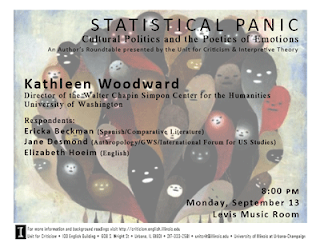
 [On Monday, September 13, the Unit for Criticism held the first of its Fall 2010 Author’s Roundtables, hosting Kathleen Woodward who discussed her book, Statistical Panic: Cultural Politics and the Poetics of Emotions (Duke 2009). Below guest writer Michael Simeone provides an overview of the event. (A second post below includes the work of all three respondents]
Written by Michael Simeone (English)
One of the most gratifying aspects of Woodward’s recent work is its inclusive mode of argumentation. During the September 13, 2010 presentation and following discussion, there was a current that went through the room as audience members and respondents alike began connecting their own experiences and observations with Woodward’s overall framework of emotions, subjectivity, and statistics. Woodward mentioned repeatedly that the tone of her book was not so much an assertive argument meant to displace an existing perspective, but rather one that would be associational, inviting, and agglomerative. It seems to have worked.
But one connection between Woodward’s work and the present tense tended to repeat: the conventions of scholarly publishing. Academic writing has become increasingly emotionless and de-personalized, she argued, consonant with the impoverishment of human emotional interiority in the face of neo-liberal capitalism. For Woodward, there are no emotions in articles, no sense of personal stakes in books, making up a pervasive aesthetic of “professional cool.”
Once published by university presses, books and articles go back into university libraries, where they remain guarded from the non-academic public. Accessing an article on JSTOR or checking a book out from the main stacks requires a University ID number. That number costs a considerable sum. Even walking into a library resembles walking into airport security; checking items in lockers, scanning identification cards, and passing through a gate of scanners. The end result is a depersonalized discourse accessible to a dismal fraction of the population, which itself may not even enjoy or even prefer the continued banishment of the personal from academic writing.
All of this makes for a discouraging kind of reversed alchemy, where passion and enthusiasm turn into boredom. Scholars who so frequently enjoy what they read, or are so fascinated they commit years of their lives to its study, produce writing that is demanding to produce, gray, and joyless. Woodward’s work suggests that the drain of affect from academic writing is related to the statistical panic of the future of the humanities, brought about by dismal figures that reference anything from short-term job prospects to long-term departmental budgets. Emptying out emotion from academic writing as a response to statistical panic helps produce a binary relationship between reason and affect, a way to combat the empirical persuasion of statistics with the cool power of academic sterility.
But where to go from here, if here is in fact no longer a place where there is less and less human livelihood?
 Woodward mentioned alternative forms of publication such as Vectors and NINES, as possible ways to think outside of current configurations of publication. And while there was little time for her to elaborate, I want to suggest that these forms of publication, forms where authors submit, design, curate, annotate, and publish content online by themselves or through collaboration, not only help to make scholarship more accessible, they also help to reconnect authors with the enthusiasm that motivates their scholarly interest in the first place. Statistical panic in academic writing is a version of the same kind of Cartesian thought about information that motivates (and has motivated) much of U.S. thought about information: information is immaterial, pure, and incorruptible; bodies are immediate, messy, and full of inconvenient or unpleasant emotions.
Sterile academic writing, in light of Woodward’s juxtaposition of statistical panic and scholarship, is a version of digital transcendence, the scholar’s version of Neo disappearing gaining immortality as pure data in the networks of the Matrix.
Perhaps, then, it is possible to work backwards. Maybe scholars who produce digital scholarship emerge from anonymity as the personal force that organizes and presents an online exhibit, multimedia article, or annotated collection. Instead of sliding away from view as the cold voice of reason, they are visible as the human force of inclusion, design, and significance. Thus, before they revolutionize the kind of work we do, new forms of publication and scholarship may first revolutionize the way we feel about that work.
Read more
posted under
cinema
,
digital
,
Rushing
by Unit for Criticism

Written by Robert Rushing, Comparative Literature and Italian
Michael keeps sending me pieces from the Chronicle of Higher Education, and a recent one by Thomas Doherty, entitled "Celluloid Under Siege" (April 18, 2008), makes two claims about what's happening to cinema. The first claim is almost beyond question, but the second is almost certainly wrong. The first claim is that celluloid or analog film is poised to disappear. While initial experiments in high-definition digital video seemed esoteric (or in the case of the most recent trilogy of Star Wars films, motivated more by a fetish for technology than any real necessity), it does seem clear that there is a move toward digital currently underway. It is cheaper, easier to edit, picks up a wider range of contrast in low light, and so on. Some films, like Haneke's Caché (2005), actually depend on being shot in high-definition video for their effects (in the case of Haneke's film, a persistent doubt in the viewer's mind about whether you're watching events that are "live" or "taped"). Doherty's second claim, however, is a little more surprising, and as one might guess from his title (and subtitle: "The future of film studies after the digital deluge"), somewhat alarmist: cinema studies in the American academy is in crisis, "scrambling" as the filmic substrate itself crumbles under our feet.
While celluloid may indeed be disappearing (although it remains an open question whether it will vanish entirely, as it nearly has in still photography, or become one tool among many at the director's disposal), the faculty I know who work on cinema aren't "scrambling" to deal with the changes. I would think it would be obvious, but massive shifts in reception practices on the part of ordinary viewers (who are watching films in more ways and in more venues than ever before, including YouTube and iPhones), are of course very, very good for scholars--to put it bluntly, they give us something to write about. At the same time, "Leave Britney Alone!," "The Landlord" and the practice of Rickrolling aren't exactly replacing Casablanca, Blade Runner or The Bicycle Thief in cinema courses or for ordinary viewers, because they fulfill a radically different function for viewers. Who, exactly, is picking up a date for dinner and a romantic online viral video?
Despite the claim that this a "generational divide" between "graybeards" and "Young Turks," I haven't seen much indication that the older generation of cinema studies scholars is uninterested in—let alone threatened by—the shift from analog to digital. Cinema people in general tend to be pretty technically savvy, and many simply like technology. It's self-selecting: would you go into cinema studies if you didn't have an interest in technology? And while Doherty suggests that the shift is "ironic" because it's happening just as cinema studies is acquiring some actual prestige in the academy, it's not like those same battles will have to be fought all over again. New Media studies, for example, might have to do some further work in terms of legitimizing itself, but most of the resistance to the study of new media forms has already been overcome. Cinema Journal—which Doherty sees as symptomatic of the 'crisis'—will probably have to change its name eventually, but it's already changed its content. Recent issues have covered South Koran time travel films, tourism in The L Word, professionalism in soft-core TV productions like Girls Gone Wild, and "the Shifting Representation of the Penis on the Internet with User-Generated Content" (Summer 2007, since I know you'll want to look that up, along with a great piece by my colleague J.B. Capino in the same issue on the advantages and disadvantages of using the still frame in studying pornography), in addition to more traditional film topics. This doesn't sound like a crisis to me.
Perhaps I know the wrong people (or rather more likely, the right ones), but most of the faculty I know think this is a great time to be doing work on cinema—more material is more accessible and a higher quality, and with a greater variety of moving image formats going out to more viewers in more venues than ever before. More is good. (In the interest of balance, however, I will point out what Doherty would no doubt—and rightly—point out if he were here: it is an embarrassment that we have superb, state-of-the-art facilities here at Illinois, but cannot get secure funding for a projectionist to actually show our impressive archive of films on celluloid to students, scholars, or the public. And it will become harder and harder to convince the administration to do so in a digital age. Still, on the whole, I find there is more good than bad here.)
Doherty invokes Rodowick's book Virtual Life of Film to support his claims, but we're treated to choicely nonsensical, but apocalyptic-sounding pronouncements such as: "Forget the threat to Hollywood cinema; digital crashes the hard drives of Newtonian physics." Doherty is somewhat, but only somewhat, tongue-in-cheek throughout his article, but I'm not sure how else to read this: evidently because digital cinema can so easily create special effects that seem to deny the laws of physics, those laws themselves are somehow thrown into crisis. Sound familiar? My impression—although it's only an impression—is that the viewers who are watching Lawrence of Arabia (or more likely, Superbad) on their iPhone are not staying home from the theater to do so. Rather, in addition to watching the latest releases in the theaters, people are now also catching a flick while they're standing in line at the DMV, or watching a film of their own choice rather than what the airline has selected for them while flying across the country. And who can blame them? Would they rather see those same films on a 40 foot screen? Of course. Is it a good thing that they can watch them anyway, even on a small screen? I think so. I'll admit it: I watch movies on my iPod Touch when I fly. I'd watch them on the larger laptop screen, but usually my son manages to get dibs on it first. Anything is better than watching the execrable Yours, Mine and Ours (2005) and the scattering of infomercials and Everybody Loves Raymond that you're lucky to get on an airplane these days. Not only would I rather watch Snakes on a Plane, I'd rather have actual snakes on my plane. Anyway, the quality on the Touch isn't bad, and I'll catch a new release in the theaters after we land. It might be shot on digital, but it also might be good.
Read more
top

 Woodward mentioned alternative forms of publication such as Vectors and NINES, as possible ways to think outside of current configurations of publication. And while there was little time for her to elaborate, I want to suggest that these forms of publication, forms where authors submit, design, curate, annotate, and publish content online by themselves or through collaboration, not only help to make scholarship more accessible, they also help to reconnect authors with the enthusiasm that motivates their scholarly interest in the first place. Statistical panic in academic writing is a version of the same kind of Cartesian thought about information that motivates (and has motivated) much of U.S. thought about information: information is immaterial, pure, and incorruptible; bodies are immediate, messy, and full of inconvenient or unpleasant emotions.