[On Monday, March 28, 2011, the Unit for Criticism hosted "'My Brother is Not a Pig': Philippine Cinema against Empire," a lecture by José B. Capino, professor of English, Asian American Studies, Cinema Studies, and Gender & Women's Studies at the University of Illinois. The below contributions are from the event's guest writer, Diana Jaher, and faculty respondent, Augusto Espiritu]
José B. Capino's "'My Brother is Not a Pig': Philippine Cinema against Empire"
Written by Diana Jaher (Theatre, Cinema Studies, Gender and Women's Studies)
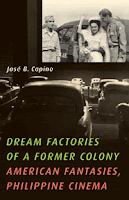 In a talk derived from his book, Dream Factories of a Former Colony: American Fantasies, Philippine Cinema (U of Minnesota P, 2010), José B. Capino analyzed Philippine cinematic representations of the country’s relationship with the United States from 1947 to the present. He argued that the cinema (a thriving industry that produces 280 films a year) often depicts the Philippines’ complex postcolonial attachment to its former “benevolent big brother,” a relationship characterized by “deep resentment and lingering affection.”
The U.S. colonized the Philippines from 1898 to 1946, granting independence to this important ally after World War II. Throughout its occupation, the United States asserted that its role was not to conquer but to protect – what President McKinley referred to as “benevolent assimilation, substituting the mild sway of justice and right for arbitrary rule.” In his postcolonial readings of two films, Once a Moth (Lupita Aquino-Kashiwahara, Philippines, 1976) and PX (Lino Brocka, Philippines, 1982), Capino argued that the films' depictions of Philippine/U.S. relations subvert the image of U.S. paternalism and, instead, reveal a systematic pattern of neglect and abuse by the most imperialist of all American institutions: the U.S. military.
Both movies use the American air base (through which the U.S. maintained a military presence in the Philippines for decades after independence) to symbolize the violence inherent in imperial domination. Much of their cruelty stems from the United States’ insistence on maintaining sovereignty while occupying foreign territory. American G.I.s, for example, were not subject to Philippine law and were given immunity from crimes committed in the line of duty against non-Americans in or around military camps. Between 1952-64, G.I.s were suspected of killing thirty-one Filipinos; none was convicted. Showing several graphic clips depicting natives victimized by American aggression while on or near a base, Capino argued that the two films implicitly called for the closing of the camps, challenging the myth of the United States as a benevolent empire.
 Once a Moth features Filipino superstar Nora Aunor as Corazon de la Cruz, a nurse whose young brother, Carlito, is mistaken for a boar while flying a kite near Clark Air Force Base and killed by American G.I.s. When an army official attempts to hand Cora a check for $787 and explains, half-apologetically, the shooter’s mistake, the young woman (uttering the most famous line in Philippine cinematic history) cries out, “My brother is not a pig.”
Capino noted that Carlito’s death illustrates Frantz Fanon’s theory that the native victim of imperialism is reduced to an animal (to heighten this connection, the film shows us an image of a dead pig with the boy’s murdered body), and that death at the hands of the colonizers is his or her usual fate. But Cora’s words demand that we acknowledge her brother’s humanity (he is not a pig, either literally or figuratively) in the face of global military domination.
Yet, as Capino argued throughout the lecture, Filipinos are deeply ambivalent about their former “protectors.” For example, during the funeral, Carlito’s grandfather (Paquito Salcedo) remembers a moment of United States/Philippine solidarity when he recalls the Bataan Death March. Images of the March – forced on U.S. and Filipino POWS by the Japanese (another foreign invader) – are intercut with frames of the murdered boy’s burial. Capino held that these memories of commonality deny Grandpa “the freedom to despise the United States and mourn his nation.”
Moth ends with a striking vision of reversal. Injured in a motorcycle accident, Carlito’s shooter depends upon Cora’s nursing skills to survive. The native woman redeems the ex-colonizer for his lack of “benevolence” by tending to her brother’s murderer. And, more importantly, she gains control over life and death – a power hitherto solely in the hands of the Americans.
In his analysis of the second film, PX, Capino referenced the Foucauldian notion of bio-politics for a second time: the base, once again, is a site of life and death. As in Moth, we see the youngest and most helpless characters die in acts of senseless violence. PX similarly revolves around a character with conflicted feelings for the United States: in this case, Lydia (Hilda Koronel), an Amerasian haunted by her paternity who dreams of marrying an American soldier like her father and immigrating to his country. Half colonizer and half colonized, Lydia possesses what Capino called a “divided heart:” a victim who demonstrates affection for her victimizer, she represents the Philippine colonial attachment to the fantasy of U.S. benevolence.
 Lydia's criminal boyfriend, Isidro (Phillip Salvador), expresses similar “divided” feelings for the U.S. He puts his young brother through school to learn English, exhibiting pride in the boy’s ability to, as Capino noted, “speak the conqueror’s tongue.” But the boy falls victim to Carlito’s fate: he, too, is mistakenly shot by base soldiers. After the child’s death, Lydia and her boyfriend resolve never again to love the American who lives on the base. But his is one of several deaths; the others are prostitutes whose murderer(s) are never found (film image left). Death permeates the camp, attacking the most vulnerable (women, children) for it is the “throwaways” – Fanon’s “wretched of the earth” – who always die in greatest numbers, embodying the failure of imperial benevolence.
 Clark Air Base closed in the early 1990s but Capino noted that the two films’ political influence is unclear (although Moth enjoyed economic and critical success – largely because of Aunor’s star power – PX did not). Yet incidents of colonialist violence still occur. The most recent – and notorious – episode happened in 2005 when Daniel Smith, an American G.I. convicted of raping a Philippine woman (“Nicole”), was smuggled out of jail. Pressured by the U.S. government who threatened to withdraw valuable monetary aid, the Philippine officials turned him over to the U.S. Embassy. Like the raped and murdered women in PX, Nicole’s native body is violated by an act of U.S. imperialism, her dignity deemed expendable by the military industrial complex.
In his response to Capino’s framing of Philippine cinema in the shadow of post-U.S. imperialism, Augusto Espiritu referenced some of the incidents detailed above, noting that the long history of Philippine/U.S. relations has been less than “benign.” Today, the U.S. still fails to acknowledge or attend to the neglect of Filipino bodies; they remain “throwaway” people. He also commented on the films’ reliance on feminine iconography (most of the clips featured female characters), arguing that the colonized woman exercises power – often on “behalf of the weakened colonial man” – over the white male colonizer. In the question and answer session, several audience members also mentioned this trope; Capino offered Rey Chow’s theory that the primitive woman often bears the burden of representation.
Espiritu concluded by noting that images of U.S. extra-territorial aggression can be found in many places other than the Philippines – Honduras, Okinawa, Iraq, Afghanistan – anywhere the United States maintains a military presence and violates native female and male bodies with impunity [read further for Espiritu's response].
Return to top of page
A response by Augusto Espiritu (History, Asian American Studies, Latin American and Caribbean Studies)
It was in 1995 at Ambassador Negroponte’s house in Manila that I attended a dinner hosted by the ambassador and his wife. To my surprise half the room was made up of American soldiers in fatigues. They were taking a respite from military exercises with the Philippine government in anticipation of a potential invasion of Taiwan by China. It had only been three years since U.S. control over Clark Air Base and Subic Bay Naval Base had been turned over to the Philippine government. I thought to myself then – they were back so soon. Had the Americans really left?
 I also happened to visit the city of Angeles, Pampanga at that time and to see Clark Air Base for myself – we were there to shop in the huge supermarkets that had hastily sprung up to fill the vacuum of the old PX. I walked through the old base – it was a ghost town. It was covered in lahar, volcanic ashes that had rained down from the sky. All I could see were dark holes, like eyes, where there were once doors and windows. So much nationalist agitation and activism over decades of struggle could not dislodge the U.S. military, but this apocalyptic ash, which darkened the sky and choked one’s breath, achieved what no effort by the colonized or neo-colonized could do – sent the proverbial kanó packing. Or so I thought.
José Capino’s paper deals with the way two Philippine films, Minsa’y isang gamu-gamo (Once a Moth) and PX, argued for the closure of the U.S. bases, exposing their ills and representing their complex social ramifications even as the Marcos dictatorship negotiated with the Americans to maintain them, though for higher “rent.” Lupita Aquino Concio, or Lupita Aquino Kashiwahara, directed the first, while Lino Brocka, perhaps the greatest name in Filipino film-making, directed PX.
 Once a Moth juxtaposes a despedida, or send-off for a young woman headed to the “States” with the shooting of her younger brother for trespassing in Crow Valley firing range, near Clark Airfield, while he was flying a kite (image left) and mistaken for a “boar.” Through the images of Cora crashing on the tinikling and her brother’s red-white-and blue kite, Concio gives us a picture of “stunted expression,” or better yet, arrested sovereignty, victimized by American naked imperial rights to “extraterritoriality” and at the same time lured by the promises of the discourse of “benevolence” with which it justifies its imperial presence.
PX is much more complex in plot – it involves natives and an American soldier banned from the base and yet, indeed by their very exclusion, made a marginal part of the imperial geography that radiates out from the base, which Capino pictures as exhibiting the characteristics of a concentration camp, a “place that is neither outside nor inside the sovereign sphere,” which combines a politics of life with a politics of death, indeed, “the politics of life as one of death.”  Lydia, a prostitute of mixed race, becomes involved in a relationship with Isidro, a Filipino hit man under the employ of both corrupt Filipinos and Americans near the base, who is involved in a drug and prostitution ring. Isidro, nonetheless, puts his brother, Boy, through school, for Boy’s education embodies his hopes of being able to get out of the “throwaway” life that he and his family inhabit.
Lydia, who wavers between a love and hatred for America, “embodies the figure of the ex-colonized ‘as the living haunt of contradictions’” while Isidro embodies the Fanonian “figure of the native afflicted with a ‘homicidal melancholia.’” It also involves how George, a white American soldier, mistakes a young Filipino for an animal, shoots him in the Crow Valley firing range, and then himself becomes a scapegoat and is hunted down. In order to survive, he has to rely on poor natives and on the friendship of Lydia, with whom he becomes involved – a “fantasy of a special relationship.” Lydia becomes conflicted about his budding love for whiteness and the fact that the boy killed in the encounter was the brother of her boyfriend.
But on another level, armed with pointed quotes from Michel Foucault, Jacques Derrida, and Giorgio Agamben, Capino’s piece is about the ways these films stage both the strange predicament of the biopower of the colonized woman over the white male colonizer and, simultaneously, thanatopolitics, the abjection of expanding circles of Filipino and Filipina subjects, their excretion from the body politic as prostitutes and as rape victims, the evisceration of their subjectivity, and their naked exposure to the material and discursive technologies of biopower.
In the case of the former, the nurse Cora, who is defeated in the courts, failing to undo the extraterritoriality law by which her brother’s death is left unpunished, treats a GI in desperate medical need after a motorcycle accident. As Capino writes, “Cora redeems the ex-colonizer from his lack of benevolence, for the sake of the future and for the sake of others who may yet require the benevolence of empire.” In the case of the latter, we are shown the fate of the three prostitutes murdered under mysterious circumstances: Tina, the young woman raped by multiple assailants; Luisa, the table dancer who wanted to go to America, took chances with American GI boyfriends, and is found stuffed with a trowel; and Josie, the confidant of Lydia.
José Capino’s work shows us that we cannot forget; we cannot subscribe to the view that the long history of United States and Philippine relations has been an unequivocally benign one, which the recent Bush administration so damagingly promoted. The Philippines of recent history has become once again a peripheral country and people from the ethnocentric viewpoint of the U.S. bases – it is but a useful lesson in counterinsurgency for the prosecution of the war in Iraq, never mind the concentration camps, the illnesses, and the tortures that attended that war and led to so much suffering. Here, Capino is saying to us that the “postcolonial” history of the Philippines and the United States has so far failed to attend to the neglect of Filipino and Filipina bodies, which had become and continues to remain disposable, “throw-away” people – the lives of children of mixed-race, prostitutes, poor people, women especially, and one might add, minorities on the base. And empire continues, in the guise of the extraterritoriality that makes the violation of vulnerable male and female “native” bodies acceptable, unpunishable.
The films he so ably interprets might stand as crying testimonies to unsolved crimes and remaining injustices, and in so doing, recall for us the mouths and bodies of so many women, as of a young girl raped in Okinawa or South Korea, or the cries of the women of Juarez and throughout Mexico, or the countless victims of sexual abuse in Honduras. They recall as well the lives of so many young people, victimized not by honest mistakes, but by “animalization,” and the twisted logic and geographies of these zones of presumed “sovereignty.”
It may be Clark Airfield or the Crow Valley firing zone this time, but it could just as well be the outskirts of U.S. military bases in Seoul or in Okinawa, Vieques, Guantánamo, or the new ones sprouting up in Colombia.
Return to top of page
Read more
posted under
1960s
,
Antonioni
,
cinema
,
Gursky
,
Mad Men
,
Mad World
,
Rushing
by Unit for Criticism

[ The second in the Unit for Criticism's multi-authored series of posts on Season 4 of AMC's Mad Men was published in anticipation of MAD WORLD: Sex, Politics, Style, and the 1960s (Duke University Press.]
"POTEMKINVILLE"
Written by Robert A. Rushing (Associate Director, Unit for Criticism/Italian/Comparative Literature/Cinema Studies)
Like virtually every episode of Mad Men, “Christmas Comes But Once a Year,” which aired this Sunday, is an episode about appearances, usually deceptive ones. The title refers back to a 1936 cartoon of the same name from Fleischer Studios (Superman, Betty Boop, Popeye, etc.) in which Professor Grampy, singing the title song, pretends to be Santa Claus for the children in an orphanage.
This Mad Men episode is anything but a consoling fable for orphans: the increasingly creepy Glen Bishop (played by Matt Weiner’s son Marten) warns Sally Draper that, despite the apparent stability of her new family, changes are coming: “After a while, they'll have another baby.” And later he notes about their equally apparently stable house: “you’ll be moving soon.” Meanwhile Peggy becomes a virgin for the second time with her new boyfriend—yet another example of “something that never happened,” a virtual mantra for Mad Men; Don suggests as much to his secretary, Allison, after having sex with her on his couch (although “next time on Mad Men” suggests that perhaps this storyline isn’t over).
Referring to the chic but sterile decor of the Sterling Cooper Draper Pryce advertising agency, Roger Sterling says that his visitor shouldn't be fooled—“it's really Potemkinville.” Roger is referring to the so-called “Potemkin villages,” towns originally created to impress the Czar, but most memorably used by the Soviets for pure show, propaganda to show off the happy wonders of socialism. In the last post on Mad Men, Lilya Kaganovsky referred to the “missing piece” of SCDP, the absent second story, but this is just as easily represented as a question of surface and depth. SCDP, in this episode, is just a façade.
SCDP’s Potemkin village status returns later in the episode, when the financially strapped agency has to put on a cinematic Madison Avenue Christmas Party for Lee Garner, Jr., the son of the owner of their main client, Lucky Strike cigarettes. “I've seen the movies,” Lee Jr. says, no doubt referring to the infamous Christmas office party in The Apartment (1960). “We need to change [the party's] rating from ‘convalescent home’ to ‘Roman orgy,’” quips Roger. In other words, both economic systems are revealed as essentially hollow: if the Soviets preferred to show unexpected visitors villages filled with happy peasants overflowing with grain, SCDP will offer up instead the glamour of advertising magic fused with cinema, something that they now specialize in after Don's High Noon Glo-Coat commercial (itself a flat prison surface revealed to be an open three-dimensional space). But instead of selling Glo-Coat by way of High Noon, they will sell SCDP by way of Caligula.
Mad Men itself has always done just this: sold itself by way of cinema. Its cinematic references are too numerous to enumerate exhaustively, but as I argue in my chapter in the Mad World volume, it shows a number of debts to Antonioni, the modernist Italian director responsible for L'avventura and Blow-Up. Those debts are thematic, but they are also stylistic, even purely formal: long takes, slow action, an absence of dialogue in key scenes, elaborate framing and positioning of characters for purely visual or geometric effect, and so on.
Mad Men here faces a kind of stylistic dilemma: on the one hand, it has dedicated-- famously--vast resources and energy to an exact and faithful mimesis. That is so much the case that the few trivial mistakes (Bryn Mawr didn't have sororities, so Betty can't have belonged to one) are well-known, the exceptions that prove the rule. Mad Men is invested in realism (perhaps more of the 19th-century variety than of the postwar Italian film sort), and the attendant socio-economic depth that realism wants to reveal behind the façade of customs and trappings. And yet the show's realist impulses constantly run up against its love of style and form. Let us take three shots from this past Sunday’s episode.
 This is a typical shot from the show: a meticulous mise-en-scéne, with period wallpaper, precisely the right clothes, the clutter of half-done homework and half-finished food preparation (carrots, potatoes and, are those turnips?)—no doubt the spices in the spice rack are all in period bottles with the tint labels for 1964. But on a second or third glance, one notices the strange color harmony of the shot, the way that Sally Draper's dress picks up the patterns of the wallpaper, that Carla's apron and dress match the tonal palette of the Draper kitchen. It is their space, but in a way that Mad Men's formalism renders almost uncanny.
Sally's dress does not just pick the geometric squares of the wallpaper; it is also black and red, the colors of Glen Bishop's lanyard, which we see in the episode's opening sequence. “Those are good colors,” Sally announces when she sees it, and now the colors appear on her dress, just as she receives a phone call from Glen. The cosmic formalism of the show is one in which a perfect realism, chaotic and contingent, shows the constant distorting traces of a god—one fond of symbolic color matching.
 All of the same observations apply here: perfect period costumes, a meticulous recreation of appropriate Christmas foods for 1964, lovingly warmed in chafing dishes atop period cans of Sterno, and a typical conga line dance. And yet Joan appears to have selected the party decorations to match the exact shade of her dress, or vice-versa. Still shots of Mad Men begin to resemble a Gursky photograph: socio-economic realism transformed into a beguiling limited color palette, played out across repeating geometric patterns. This apparent contradiction is surely one of the things about the show that puts off those who don't like it: in this view, Mad Men transforms important depth into attractive but superficial surface. At times, the show reaches for a degree of stylization that goes beyond Antonioni’s cinematic arrangement and Gurksy's formalist photography, and reaches for the painterly: Don Draper in an Edward Hopper painting.
 But appearances also tell the truth: In a sequence both comic and disturbing, Lee Jr. forces Roger into an impersonation of Santa Claus, and then photographs him with the men of the agency sitting on his lap. Those images are simply a double exposure of the truth about both men: Roger is indeed a dirty old man (one can easily imagine him saying just so to his beloved “Joanie” in a different context), and Lee is perfectly happy to have his same-sex desires made visible, but sadistically projected onto another—particularly in a way that perverts the traditional figure of authority, the father he loathes and whose shadow he stands in.
 Lee Jr. briefly becomes a character from a David Lynch film (we already knew he was a monster from his previous interactions with Sal Romano), arranging his helpless victim into a perverse mise-en-scéne and taking picture after picture, ripping the cover off of each Polaroid with a kind of sexual glee. The truth of the sequence is all on the surface: Lee Garner Jr.'s sadism and psycho-sexual conflicts, his Oedipal issues, Roger as dirty old man—even Christmas itself as an already perverse scenario of sexual dependence.
Everything about the episode insists on this last point, the fundamentally “adult” character of Christmas in capitalist America, from the Roman office orgy to Don's drunken grappling with his secretary. All of them are based on the figure of the “sugar daddy,” the one who provides “gifts” (two fifty dollar bills, the continuing business of Lucky Strike cigarettes) in exchange for sexual acts (quickie on Don's sofa, humiliating Polaroids of yourself in costume). (It doesn’t always work: the SCDP artist Joey attempts to win over Allison with a cartoon of her as Aphrodite, goddess of love, but it doesn’t take.)
The horror of Glen Bishop is that he has always been ahead of the curve, too sexual too early, and he both sadistically defaces Betty's home in revenge for her “infidelity,” while offering Sally Draper in her unspoiled room a “Christmas gift,” whose sexual promise—or menace—is clear (it is the black-and-red lanyard that was attached to his knife, left on her bed). All of these “concealed truths” are completely open, on the surface, self-developing Polaroids. The shallow and formulaic Christmas card that Don leaves for his secretary really is thanking her for all her hard work (in the office, and on the couch), just as the truth of Christmas is on display every year and in the closing credits in the form of a grotesque hit song: “I Saw Mommy Kissing Santa Claus.” (If you like, this is the “work” of the episode, the transformation of the sweet and child-appropriate 1936 song “Christmas Comes But Once a Year” into the sexual and ambiguous 1952 Jimmy Boyd hit.)
Dr. Faye Miller, a specialist in consumer evaluation (an early form of focus groups) who seems both professionally and personally fascinated by Don, offers a differing view: advertising exists, she suggests, in order to resolve the conflict between depth and surface. There is, on the one hand, what people secretly want, their most venal and banal of desires, and there is how they are supposed to behave (civilization and its discontents): depth and appearance. Advertising, according to Dr. Miller, is what mediates between the two, offering a lie that also tells the truth, the deepest desire in the guise of something socially acceptable.
The trick in viewing Mad Men is not to look for the ways in which it fails to address “serious” topics of weighty political importance (the show is trivial, superficial, glamorizes mere consumption, etc.), but instead to seek out the many ways in which the show's superficiality, and the superficiality of its characters, speak to precisely the realist truths its gloss sometimes seems to slide over. This is not direct, didactic and political speech, however—and as a result, it can maintain the fascination and glamorous power of images.
Surfaces that conceal, surfaces that reveal. This double play of the surface appears quite forcefully, and very early on in the episode. When Freddy Rumsen arrives with a new account, he is momentarily distracted from his double dealings (the essence of depth—depth and deception are the same) by a modernist image on the wall, an optical illusion (i.e., cinema, television) that combines depth, a flat screen and the illusion of movement.
 “I feel like I'm getting sucked into that thing,” Freddy says, but the feeling he's describing is both an irresistible attraction as well as the falling sensation of vertigo. This is, of course, another Mad Men reference to Hitchcock, but it is also once again nothing but the opening credit sequence. (I have been able to discern two absolute constants in the Mad Men universe: Pete Campbell is always right, and everything about the show can be derived from the opening credits.) The interminable play of three-dimensional spaces that turn out to be flat vector graphics, the creation of depth (falling, falling), ultimately revealed as a blank, flat, unreadable service that nonetheless exerts a magnetic attraction.
I, too, feel like I'm getting sucked into this thing.

Read more
posted under
cinema
,
digital
,
Rushing
by Unit for Criticism
Written by Robert Rushing, Comparative Literature and Italian
Michael keeps sending me pieces from the Chronicle of Higher Education, and a recent one by Thomas Doherty, entitled "Celluloid Under Siege" (April 18, 2008), makes two claims about what's happening to cinema. The first claim is almost beyond question, but the second is almost certainly wrong. The first claim is that celluloid or analog film is poised to disappear. While initial experiments in high-definition digital video seemed esoteric (or in the case of the most recent trilogy of Star Wars films, motivated more by a fetish for technology than any real necessity), it does seem clear that there is a move toward digital currently underway. It is cheaper, easier to edit, picks up a wider range of contrast in low light, and so on. Some films, like Haneke's Caché (2005), actually depend on being shot in high-definition video for their effects (in the case of Haneke's film, a persistent doubt in the viewer's mind about whether you're watching events that are "live" or "taped"). Doherty's second claim, however, is a little more surprising, and as one might guess from his title (and subtitle: "The future of film studies after the digital deluge"), somewhat alarmist: cinema studies in the American academy is in crisis, "scrambling" as the filmic substrate itself crumbles under our feet.
While celluloid may indeed be disappearing (although it remains an open question whether it will vanish entirely, as it nearly has in still photography, or become one tool among many at the director's disposal), the faculty I know who work on cinema aren't "scrambling" to deal with the changes. I would think it would be obvious, but massive shifts in reception practices on the part of ordinary viewers (who are watching films in more ways and in more venues than ever before, including YouTube and iPhones), are of course very, very good for scholars--to put it bluntly, they give us something to write about. At the same time, "Leave Britney Alone!," "The Landlord" and the practice of Rickrolling aren't exactly replacing Casablanca, Blade Runner or The Bicycle Thief in cinema courses or for ordinary viewers, because they fulfill a radically different function for viewers. Who, exactly, is picking up a date for dinner and a romantic online viral video?
Despite the claim that this a "generational divide" between "graybeards" and "Young Turks," I haven't seen much indication that the older generation of cinema studies scholars is uninterested in—let alone threatened by—the shift from analog to digital. Cinema people in general tend to be pretty technically savvy, and many simply like technology. It's self-selecting: would you go into cinema studies if you didn't have an interest in technology? And while Doherty suggests that the shift is "ironic" because it's happening just as cinema studies is acquiring some actual prestige in the academy, it's not like those same battles will have to be fought all over again. New Media studies, for example, might have to do some further work in terms of legitimizing itself, but most of the resistance to the study of new media forms has already been overcome. Cinema Journal—which Doherty sees as symptomatic of the 'crisis'—will probably have to change its name eventually, but it's already changed its content. Recent issues have covered South Koran time travel films, tourism in The L Word, professionalism in soft-core TV productions like Girls Gone Wild, and "the Shifting Representation of the Penis on the Internet with User-Generated Content" (Summer 2007, since I know you'll want to look that up, along with a great piece by my colleague J.B. Capino in the same issue on the advantages and disadvantages of using the still frame in studying pornography), in addition to more traditional film topics. This doesn't sound like a crisis to me.
Perhaps I know the wrong people (or rather more likely, the right ones), but most of the faculty I know think this is a great time to be doing work on cinema—more material is more accessible and a higher quality, and with a greater variety of moving image formats going out to more viewers in more venues than ever before. More is good. (In the interest of balance, however, I will point out what Doherty would no doubt—and rightly—point out if he were here: it is an embarrassment that we have superb, state-of-the-art facilities here at Illinois, but cannot get secure funding for a projectionist to actually show our impressive archive of films on celluloid to students, scholars, or the public. And it will become harder and harder to convince the administration to do so in a digital age. Still, on the whole, I find there is more good than bad here.)
Doherty invokes Rodowick's book Virtual Life of Film to support his claims, but we're treated to choicely nonsensical, but apocalyptic-sounding pronouncements such as: "Forget the threat to Hollywood cinema; digital crashes the hard drives of Newtonian physics." Doherty is somewhat, but only somewhat, tongue-in-cheek throughout his article, but I'm not sure how else to read this: evidently because digital cinema can so easily create special effects that seem to deny the laws of physics, those laws themselves are somehow thrown into crisis. Sound familiar? My impression—although it's only an impression—is that the viewers who are watching Lawrence of Arabia (or more likely, Superbad) on their iPhone are not staying home from the theater to do so. Rather, in addition to watching the latest releases in the theaters, people are now also catching a flick while they're standing in line at the DMV, or watching a film of their own choice rather than what the airline has selected for them while flying across the country. And who can blame them? Would they rather see those same films on a 40 foot screen? Of course. Is it a good thing that they can watch them anyway, even on a small screen? I think so. I'll admit it: I watch movies on my iPod Touch when I fly. I'd watch them on the larger laptop screen, but usually my son manages to get dibs on it first. Anything is better than watching the execrable Yours, Mine and Ours (2005) and the scattering of infomercials and Everybody Loves Raymond that you're lucky to get on an airplane these days. Not only would I rather watch Snakes on a Plane, I'd rather have actual snakes on my plane. Anyway, the quality on the Touch isn't bad, and I'll catch a new release in the theaters after we land. It might be shot on digital, but it also might be good.
Read more
posted under
cinema
,
cultural studies
,
Rushing
,
Sayles
by Unit for Criticism
Written by Robert Rushing, Comparative and World Literature
In a recent article (you'll need a subscription to read, however) in the Chronicle of Higher Education, David Shumway wonders why filmmaker John Sayles hasn't gotten much attention in the academy. So why doesn't cultural studies love John Sayles, as Shumway asks in the article's title? He offers several possible explanations, concentrating on the absence of critical articles on Sayles and cultural studies. He writes:
"Sayles's films are often described as didactic, and they are.… they promote a general set of political values, including equality, tolerance and appreciation of difference, and an ethic of community… [but] perhaps it is less that Sayles has political points to make than the way in which he makes them. A colleague remarked that despite feeling sympathetic toward his politics, she wished he wouldn't express them with such earnestness. Unlike in the 1970s, when directors like Robert Altman used studio-era genres ironically, Sayles plays it straight. Michael Moore draws audiences to his polemics by making fun of the other side, something Sayles rarely does.… It is worth recalling that Andrew Sarris's most damning classification in his seminal study of auteurs, The American Cinema, was "strained seriousness." It seems as though the worst sin an American film director can commit is to treat serious issues seriously."
I don't think this is a problem specific to cultural studies, since there isn't a ton of work on Sayles in cinema studies, either (it certainly isn't absent, but it does tend to biographies and interviews). Cultural studies, as Shumway notes, tends to be interested in texts that either appear to be non-ideological while actually concealing a reinforcement of the dominant ideology (often high culture texts) or those that are concealing a form of resistance to dominant ideology while appearing to be mere entertainment (often popular culture). But this bias (or preference) is not limited to cultural studies. Almost all of the humanistic disciplines that interpret in one capacity or another—that is, all of those fields that take something like a "text" as their object of study—duplicate it. They are all fundamentally exegetical in their approach, positing a model of the object of study that conceals a hidden message which must be laboriously unveiled by an expert for the uninitiated. This is the task of the scholar, and most theoretical models follow this approach (Hegel, Marx, Freud, Foucault, and so on—analysis or archaeology or whatever will reveal a hidden truth of ideology, economics, the unconscious…). Lacan offers only a slight variation on this formula when he argues that truth is concealed on the outside, in plain view. But it is still concealed, and it still requires an expert to decode, decipher, explicate, gloss, articulate—all of our favorite verbs.
The problem with Sayles is that his maligned "earnestness" is precisely the desire to speak plainly, to say what you mean without any concealment. He resists the dominant ideology, but not in a way that is hidden or concealed in some kind of pop confection. Numerous studies of action films done in the 1990s, for example, concluded almost universally that the hyperbolic masculinity of action films like Rambo or Die Hard was less about machismo than they were about masculinity in crisis, on the edge, in a panic. (Is Rambo secretly politically progressive?) Now that's a satisfying argument. This structure is familiar and pleasing to anyone who has "queered" a text that was formerly apparently heteronormative (one can imagine the MLA paper title already: "Lesbian Desire in Chick Lit: Bridget Jones' Secret Diary"), or discovered that an apparently progressive film actually reinforces the dominant ideology. Sayles' films leave the professional exegete with nothing to say, because there is no layer underneath the surface to be revealed.
I don't think there's anything wrong with this kind of work, of course (I'm guessing all of my research work falls into this "exegetical" category). In fact, I think that this is perhaps the single greatest pleasure of my job, but it is a pleasure that is not without its negative side. On the one hand, it is a pleasure that stems from a love of engagement with the text, knowledge about it and about its context; on the other hand, it owes much of its power to an exclusivity—"I possess the secret key to explaining David Lynch's films," or "We understand Lacan, and perhaps we will let you into our club—and perhaps we won't." At its worst, this kind of approach can be deeply elitist (you think Lynch is a mess of surrealist images, but that's because you do not see (you are too stupid to see) the hidden messages, the hidden kernel of the real, the de-subjectified voice, the…). Sayles, in short, poses the problem of the middlebrow: it has no unintentional camp humor, no incomprehensible or enigmatic imagery, no radical formalist experimentation, and as a result, there's nothing to elucidate. In this way, Sayles may be politically and socially progressive, but profoundly un-academic. To pose this all as a question, are academics unable to deal with texts that are straightforward, that need no interpretation, or is this an "impossible object" that we constitute ourselves around?
* * * * * *
My introduction to the films of John Sayles came surprisingly early, especially for a teenage fan of heavy metal in Southern California who'd seen at most 5 or 6 films by the early 1980s. My idea of intellectual depth at the time was Rush lyrics. But late one night watching TV with my best friend, whose parents were rarely around and let us stay up as late as we liked, we happened to catch Brother from Another Planet, and we loved it. We loved it in much the same way that we loved Monty Python, or Altered States, or any other film that we found "weird." I liked Joe Morton in the role of the alien who happens to appear as an African-American to Earthling eyes (he is mute throughout the film). But even at the age of 15 or so I understood that the film was an allegory (hey, there was allegory in Rush lyrics!), that Morton's alien was a refugee slave, that the film was duplicating America's history of slavery in space so we could see it as something still present.
I didn't see the film again until my first year in college. I went to UC Santa Cruz, and ended up at Oakes College there, the multiculturally-themed college. Our core course at Oakes was organized around different cultural identities, and had a rather tokenistic organization (this week, Asians! next week, gays!). And for each week, a film. For the week on African Americans, we saw Brother from Another Planet. The African American students in the class were outraged. "This was our film?" one African American student asked, aghast.
So here's a problem that cultural studies might find more appealing, one that it's potentially well-suited to: why did Sayles' progressivism "strike out" with the very community that he presumably wanted to speak to (and certainly was speaking about)? Sayles is much liked in the independent film community and by progressives, but the working class he's championed are far more likely to have seen Transformers than, say, City of Hope. Can culture be progressive (or revolutionary) and popular? Adorno? Benjamin?
Read more
top
 [On Monday, March 28, 2011, the Unit for Criticism hosted "'My Brother is Not a Pig': Philippine Cinema against Empire," a lecture by José B. Capino, professor of English, Asian American Studies, Cinema Studies, and Gender & Women's Studies at the University of Illinois. The below contributions are from the event's guest writer, Diana Jaher, and faculty respondent, Augusto Espiritu]
 In a talk derived from his book, Dream Factories of a Former Colony: American Fantasies, Philippine Cinema (U of Minnesota P, 2010), José B. Capino analyzed Philippine cinematic representations of the country’s relationship with the United States from 1947 to the present. He argued that the cinema (a thriving industry that produces 280 films a year) often depicts the Philippines’ complex postcolonial attachment to its former “benevolent big brother,” a relationship characterized by “deep resentment and lingering affection.”
 Once a Moth features Filipino superstar Nora Aunor as Corazon de la Cruz, a nurse whose young brother, Carlito, is mistaken for a boar while flying a kite near Clark Air Force Base and killed by American G.I.s. When an army official attempts to hand Cora a check for $787 and explains, half-apologetically, the shooter’s mistake, the young woman (uttering the most famous line in Philippine cinematic history) cries out, “My brother is not a pig.”
 Lydia's criminal boyfriend, Isidro (Phillip Salvador), expresses similar “divided” feelings for the U.S. He puts his young brother through school to learn English, exhibiting pride in the boy’s ability to, as Capino noted, “speak the conqueror’s tongue.” But the boy falls victim to Carlito’s fate: he, too, is mistakenly shot by base soldiers. After the child’s death, Lydia and her boyfriend resolve never again to love the American who lives on the base. But his is one of several deaths; the others are prostitutes whose murderer(s) are never found (film image left). Death permeates the camp, attacking the most vulnerable (women, children) for it is the “throwaways” – Fanon’s “wretched of the earth” – who always die in greatest numbers, embodying the failure of imperial benevolence.
 Clark Air Base closed in the early 1990s but Capino noted that the two films’ political influence is unclear (although Moth enjoyed economic and critical success – largely because of Aunor’s star power – PX did not). Yet incidents of colonialist violence still occur. The most recent – and notorious – episode happened in 2005 when Daniel Smith, an American G.I. convicted of raping a Philippine woman (“Nicole”), was smuggled out of jail. Pressured by the U.S. government who threatened to withdraw valuable monetary aid, the Philippine officials turned him over to the U.S. Embassy. Like the raped and murdered women in PX, Nicole’s native body is violated by an act of U.S. imperialism, her dignity deemed expendable by the military industrial complex.
 I also happened to visit the city of Angeles, Pampanga at that time and to see Clark Air Base for myself – we were there to shop in the huge supermarkets that had hastily sprung up to fill the vacuum of the old PX. I walked through the old base – it was a ghost town. It was covered in lahar, volcanic ashes that had rained down from the sky. All I could see were dark holes, like eyes, where there were once doors and windows. So much nationalist agitation and activism over decades of struggle could not dislodge the U.S. military, but this apocalyptic ash, which darkened the sky and choked one’s breath, achieved what no effort by the colonized or neo-colonized could do – sent the proverbial kanó packing. Or so I thought.
 Once a Moth juxtaposes a despedida, or send-off for a young woman headed to the “States” with the shooting of her younger brother for trespassing in Crow Valley firing range, near Clark Airfield, while he was flying a kite (image left) and mistaken for a “boar.” Through the images of Cora crashing on the tinikling and her brother’s red-white-and blue kite, Concio gives us a picture of “stunted expression,” or better yet, arrested sovereignty, victimized by American naked imperial rights to “extraterritoriality” and at the same time lured by the promises of the discourse of “benevolence” with which it justifies its imperial presence.
 Lydia, a prostitute of mixed race, becomes involved in a relationship with Isidro, a Filipino hit man under the employ of both corrupt Filipinos and Americans near the base, who is involved in a drug and prostitution ring. Isidro, nonetheless, puts his brother, Boy, through school, for Boy’s education embodies his hopes of being able to get out of the “throwaway” life that he and his family inhabit.