Mad World on Kritik: Mad Men Season 5.1/2
"Things Aren't Perfect"
Guest Writer: Lilya Kaganovsky

Tuesday, March 27, 2012


[The first in the Unit for Criticism's multi-authored series of posts on Season 5 of AMC's Mad Men, prior to the publication of MAD MENMAD WORLD: Sex, Politics, Style, and the 1960s (Duke University Press) Eds. Lauren M. E. Goodlad, Lilya Kaganovsky and Robert A. Rushing

"Things Aren't Perfect"

Written by Lilya Kaganovsky (Slavic/Comparative Literature/Media & Cinema Studies)

Mad Men is growing old. I don’t mean that as a criticism;I mean that the show, without being a Bildungsroman (since no one ever grows wiser here, only older), is fundamentally about what it means to be an adult. Don has turned forty. Sally’s voice has dropped an octave. Joan has had a baby. Pete lives in the suburbs. Sterling Cooper Draper Pryce has entered a period of “stability” (“stable,” as Pete tells us, is that “step backwards between successful and failing”).

Even the ads for Miller 64 aired during the premiere point us to a certain demographic: “brewed for the better you.” The ad opens with an alarm clock about to turn to 6:30am and a picture of someone’s five-year old daughter on the nightstand. We are then treated to a daily routine of working out (“We run a mile before breakfast” goes the song), eating healthy (“I had a salad for lunch”), and the promise, that after a day of “balance” to have a Miller 64 with dinner because, “I’ve worked off my paunch.” Like the Heinz baked beans campaign pitched by Peggy in this episode, which imagines a “bean ballet” set to classical music and strikes the clients as old-fashioned, the Miller 64 ad is not targeted at the young “college” crowd, but at the many Mad Men viewers who, like Don, are turning forty. (“When you’re forty, how old will I be?” Don asks his son Bobby. “You'll be dead,” replies Bobby.) For his fortieth birthday, Harry gives Don a cane and Megan calls him an old man. As Betty tells Don in the Season 4 finale line repeated in the teaser that preceded Season 5’s two-hour premiere, “Things aren’t perfect.”


Season 5 opens with a picket line. Initial close ups of white police officers and passersby are quickly replaced by medium shots of black women and men carrying signs demanding work. This is the Civil Rights Movement, but it is also Occupy Wall Street, with these protests meant to reflect not only on our past, but also on our most recent historical moment. Our next series of shots takes us inside an office, which we immediately recognize as the part of an ad agency, even though we don’t know any of the four men working there: we suspect (and we will be proved wrong) that we are looking at the new Sterling Cooper Draper Pryce “creative” team — their obvious youth speaking to the next generation of Mad Men. Instead, the agency is Y&R: Young & Rubicam and, living up to their agency’s name, they react to the protests with an appropriate degree of childishness: annoyed by the noise coming from the street, they decide to “cool off” the protesters by first pouring and then throwing bags of ice water out the window. (There is an entire discourse of paper bags, barf bags, and body bags that runs through the episode.)


The opening sequence speaks to a series of changes that have taken places since we last saw our favorite characters seven months earlier (seven months by the show’s clock, seventeen months by ours). Trudy and Joan have both had their babies and each is looking a little worse for wear. As Pete Campbell puts it in his inimitable way, “there was a time when she wouldn’t leave the house in a robe.” Pete of course is speaking about Trudy, but his comment carries over to our first glimpse of Joan (preceded by a baby’s bottom and a hand applying diaper rash cream), still wearing a robe and pajamas in the middle of the afternoon. As her mother sarcastically notes, “You know you’re not exactly at your fighting weight.” (Joan begs to differ.)

Pete, meanwhile, has switched places with Don. An over-the-shoulder shot of Pete on the train is meant to remind us of our first glimpses of Don in Season 1: Pete has replaced Don on the commuter train moving between the city and its suburbs. While Don and Megan have moved into a gorgeous modern flat with a visible Manhattan skyline and audible traffic, Pete and Trudy have bought a house in the suburbs, and the shock of seeing their home for the first time is quite profound: nothing remains of the young modern couple with their well-appointed flat on the upper (upper) East side. Instead, Pete walks into what we first take to be the Drapers’ old kitchen, with the same kitchen cabinets and old-fashioned wallpaper. (To be clear, it is actually a different set, and we see a clear shot of a galley kitchen with a double sink on the right and a double stove on the left, as Pete despondently eats dry cereal out of a box — Trudy, it seems, has not yet mastered Betty’s homemaking skills.) The dingy-patterned wall paper, linoleum floor, and dark wood kitchen cabinets with their wrought-iron hinges no longer speak to the sense of bourgeois stability we first got from the Drapers’ home, before the cracks began to show. What might have passed for proper suburban upper-middle-class style five years earlier, now, in 1966, looks unbelievably shabby and depressing.

Style-wise, Season 5 does not disappoint: 1966 looks great, maybe even better than 1960 — skirts are shorter, heels are flatter, hair is longer. The colors, open space, and interior design that we first glimpsed in Palm Springs (Season 2, Episode 11, “The Jet Set”) are now part of the new Drapers’ new Manhattan home, and while we might miss Betty and her fainting couch, we know that Don has once again made the right move (“Marry early and often,” Ken Cosgrove’s wife jokes, looking at the plumper Jane Sterling.) But we also note those who are being left behind — not just Roger, who has no clients, no meetings, and has to share a secretary with Don, or Bert Cooper who waits patiently in the conference room for a meeting that’s taking place in the hallway, or Lane, who tries to seduce a young woman over the phone — but also Joan, Trudy, Jane, and even Peggy, whose clothes all speak to women aging out of the desirable twenty-something demographic. (We have yet to see Betty, of course, but I imagine that she, like Grace Kelly in Rear Window, always knows how to wear proper clothes.)

Mad Men has always been concerned with age because, unlike so much television, it is not a show about being young (it stars a leading man, for example, who even in his twenties always looked “mature”). And while we tend to associate the 1960s profoundly with youth, Mad Men wants us to see what it would have been like to live through it as adults — the “college kids” “sitting in” are not our focus. Instead, we are placed firmly inside the corporate world of bourgeois white conformism. As the Heinz client points out, speaking metaphorically for an entire generation, “beans” are not good by themselves, they are really better in a group.

Indeed, the Heinz baked beans ad campaign is one of the places we see this concern with age manifest itself. Peggy’s attempt to elevate the baked beans to the “art of supper” with new micro-photography and humor backfires, but the point is well taken: the desire to take something of humble origins to new heights. The clients wonder about the “message” — what will the viewer take away from the ad? Peggy’s claim is that it puts beans on your mind and shows you have a sense of humor, because beans are portrayed as far more important than they are. “Did you ever see beans up close?” asks the client, “They’re slimy… they look better in a group… beans is the war, the Depression, bomb shelters. We have to erase that.” “They have to be cool,” he continues, “I want kids in college… they have a hot plate, they’re sitting in… maybe it’s someone with a picket sign saying, 'We want beans!'”


A similar age gap manifests itself in Megan’s misguided desire to throw Don a surprise birthday party — she imagines that everyone loves birthdays (and surprises), while Don, as he puts it, hates to be the center of attention. That is of course not quite true: what Don hates is being the butt of a joke, which is precisely what he becomes. The title of the episode, “A Little Kiss,” is a translation of the French song Megan sings at Don’s surprise party, and it is of course not the first time that the show gives us a performance that reminds us that we are watching a spectacle. (Previous memorable sequences included Roger in blackface singing “My Old Kentucky Home,” Pete and Trudy dancing the Charleston, and Joan performing her own French song “C’est magnifique” while playing an accordion [“My Old Kentucky Home,” Season 3, Episode 3]). Megan’s “Zou bisou bisou” routine recalls Brigitte Bardot’s famous over-the-top dance in the 1956 …And God Created Woman — and while Megan is not as curvy or brilliantly seductive as BeBe (earlier, she admits to being a bad actress), the dance is excessive in the same way, breaking the bourgeois codes of propriety by turning on all the men in the room, except for Don. As is typical for Mad Men, the dance is then performed again and again as a kind of comic/traumatic repetition: first by Roger, then by Harry, then by Lane.

Don’s concern over being the butt of a joke (“You’re wondering what they’re laughing about. It’s not you,” Roger tells him; but a few scenes later, admits that he is in fact making fun of him). On some level, Don understands that his impulsive marriage to a woman nearly half his age makes him both comical and clichéd. His defense mechanism is to exercise total control over the woman he’s married, making sure that he is still our man: he demands that Megan open her blouse in his office, assumes that his own work schedule always takes priority (even when it seems he has nothing to do), and uses a fair amount of force to subdue his sex-kitten-turned-pouty-teenager. (As Don famously says to Ken in “The Hobo Code,” “you’ll realize in your private life that at a certain point seduction is over, and force is actually being requested.” [Season 1, Episode 8])

This concern over being the butt of a joke leads us back to the prank with which the episode started—the ad execs throwing water bombs out the Y& R office window. Y & R’s childish prank becomes a sign of their immaturity and bigotry, yet, in this episode, it is also an interesting device because it accomplishes, in a subtle way, a crossing of a racial divide that brings the problem of race “home,” or in this case, from the street into the office. To rub salt in their competitor’s wounds, Sterling Cooper Draper Pryce puts an ad in the Times claiming to be “An equal opportunity employer. Our windows don’t open. We are committed to proving that Madison Avenue isn’t all wet.” Rather than Y & R, however, Joan becomes the ad’s first victim, assuming that it is meant as an advertisement for her own position. Reassured by Lane that she is as needed as ever, she tries to put into words her feeling of isolation: while Lane assures her that “Nothing’s happened,” she reminds him that, “Something always happens. Things are different. Someone tells a joke and you don’t know what they’re talking about.” “There’ve been no jokes, not without you,” Lane says. “Not even at my expense?” Joan asks.

The “equal opportunity” ad is of course a joke precisely at her expense, as a series of humiliations precede the revelation of truth. While Joan initially suspects that the ad is not real, she nevertheless brings the baby to the office to see for herself — and her first set of encounters, from difficulties opening the door, to a receptionist who has never heard of her, to learning that her job is being handled by two other secretaries — leads her to a tearful breakdown in Lane’s office. (As Mary Jacobus has long ago argued, a joke is almost always at woman’s expense.Indeed, as the episode draws to a close, SCDP is in fact in the process of hiring a new girl — and the imaginary threat of replacement is made real.)

But while Joan may be the joke’s first victim, she is not its only one. Because by the time the episode is over, the joke has played out to its logical conclusion: stepping out the elevator, Don and Megan find that the SCDP lobby is full of job seekers, black men and women who have answered the want ad. While SCDP thought it was addressing itself to its competition, it was really hailing a very different group — unconsciously, it was speaking to the group that we see picketing outside the Madison Avenue offices. For the first time ever, I think, Mad Men has a message, and it is about the fact that the outside world is about to be brought inside.

The letter, Lacan says, always arrives at its destination.


Read more

12/9 Author's Roundtable 2: Dana Polan, Julia Child's The French Chef
Guest Writer: Charles Byrne

Wednesday, December 15, 2010


[On Thursday, December 9, the Unit for Criticism held the second of its Fall 2010 Author’s Roundtables. Dana Polan discussed his forthcoming Duke UP book, Julia Child's The French Chef. In our previous post we published responses by James Hay, Larry Schehr and Jing Jing Chang.]

The difference she made
Written by Charles Byrne (Philosophy)

Dana Polan’s talk on Julia Child focused on “the difference that she made” (the title of first chapter of his forthcoming book). Hearing last Thursday’s discussion and reading the two chapters available to us for the roundtable, I realized that the “difference” was a pretty substantial one.

Polan smartly ties Child’s “difference” into an impressive array of the cultural viscera of the 1960s and 70s. The discussion on Thursday repeatedly returned in various ways to Child’s “liminal” status but the chapters investigate a number of complex issues relating to Child’s place in history including, for example, the evolution of cooking shows; the division between “low” and “high” cultural artifacts; the place of public broadcasting; and the connection to fans. Child was “a liminal or transitional figure between worlds and ways of life,” in several ways including the food she chose to cook and help popularize; the structure of her TV show, The French Chef; and her own stand-out personality.

Child’s choice of French cuisine was tied up with her own experiences in France. But she took it upon herself to introduce ordinary Americans to the fare because she saw that what appealed to her in France – old world care and passion directed toward food preparation – pushed back against the increasing mechanization, commercialization, and haste in food preparation in the States, tied as it was partly to changing women’s roles (culminating, perhaps, in Peg Bracken’s I Hate to Cook Book in 1960). French cuisine was also making inroads in American culture, but was generally signified by “imperious,” intimidating spectacles like the French restaurant: Polan referred us to the 1953 I Love Lucy episode “The French Revue,” where Lucy, Ricky, Ethel, and Fred are unable to read the menus.

Respondent Lawrence Schehr pointed out, too, that historically, there has been less sizable French emigration to the US, so French cuisine seems more mysterious. For someone from the American upper class like Child, a more mainstream ethnic cooking, such as Italian, might seem somewhat vulgar – working class, garlic-infused, pungent. French cuisine, on the other hand, “is about uplift.” Still, Child was also practical in her suggestions (e.g., she allowed the use of canned stock, but only as long as spices were added). “Child brings French into America,” Polan noted, “but also America into the cuisine.” And she encouraged her viewers to believe that the French code could be conquered, that “failure is built in, but eventually you’ll succeed”; “if I can do it, you can,” she constantly reminded her viewers. Seen from today’s lens, Child’s cusine packs a horrifying caloric load, with single recipes including whole sticks of butter, cream, eggs, cheese and meat; on the other hand, Child used “ whole,” fresh, natural ingredients where possible, which certainly qualify as current “healthy” impulses.

The French Chef was filmed during a period of significant change–1963 to 1973– in television. Child’s show transitioned from black-and-white to color in the late 1960s. While far from the first cooking show – there were “hundreds” of cooking shows before hers, Polan noted – Child’s show was a new and vital force on the scene, and not only because of her personality. In fact, it seems to me that it took some time for Child to warm into the “boisterous,” “joyous” role that Polan and many others embrace; her earliest episodes show a far more sober and constrained Julia Child. When she pitched the show to public television, Child wanted it to be shot from the first-person point of view. While this idea was rejected, there were at least occasional overhead shots in the show that are suggestive of the first-person. The show itself offered far more movement than was typical; Child herself moved a great deal, rather than standing rooted behind one counter. The show would end with her procession to the dining room with the finished dish, which was actually consumed, unlike other cooking shows of the time, which rarely displayed the pleasures of eating - not to mention tasting along the way, which Child did often, to the horror of some of her germ-obsessed viewers). Her show offered touches of drama and comedy, as well as education.

Perhaps most importantly, the show managed competing needs. As a cooking show, it
was necessarily utilitarian (Ernie Kovacs’s Deadline for Dinner, mentioned by Polan, is a possible exception to this rule), but Child made it entertaining and offered unpredictable touches such as dancing chickens. The show was shot live, but heavily planned, which resulted in an overall relative smoothness but also featured bungled camera cuts and cooking mistakes, such as her famous potato pancake mis-flip. The show is chronologically straightforward, but with limited “cheats” of cooked and finished recipes (offering a “glimpse of utopia” to viewers, as Polan puts it). Ultimately, The French Chef was both practical and entertaining, and while it operated under standard cooking show constraints, it was interesting enough to a figure like Lenny Lipton to be considered avant-garde (Polan referred us to David Bordwell’s conception of "sparse cinema"). Her show helped make the burgeoning PBS, Polan advised us, into that national broadcasting vehicle formed from numerous local National Educational Television (including our own WILL).

Respondent James Hay usefully pressed our standard conception of a benign PBS, pointing out that, while largely motivated to offer more substantive, educational fare to counter the increasing commercialization of the 1950s and 60s and the perceived dumbing-down of TV, this pushback against TV as “vast wasteland” was also strongly tied to upper-class white concerns about a degraded, vulgar culture. Did PBS valorize upper-class white elites who disdained TV? Child certainly has to be seen as part of a movement with mixed motivations, conscious or not. Hay also suggests that, despite Child’s own repugnance toward commercials or brand placement, the educational television movement of which she was part has been commodified into the explosion of today’s so-called lifestyle channels (Food Network, HGTV, etc). Child’s pasted-over product labels have morphed into Martha Stewart Omnimedia and Rachael Ray Nutrish pet food.

Polan doesn’t disagree, although he insisted that Child remains a mediating figure among all of these concerns. Unlike Rachael Ray, who can wear a cashmere sweater while cooking, Child’s show involved you in the whole process of cooking by including spills and missteps. It is also hard not to notice the seemingly inevitable sexualization of some of the most popular female cooking stars of today: Rachael Ray poses for FHM,“in short-shorts with an exposed midriff, licking chocolate off a big wooden spoon”; Nigella Lawson prepares herself for a late-night date with her “Caramel Croissant Pudding,” which she takes to bed. Child serves as someone more clearly mediating traditionally masculine and feminine roles, since her height and forcefulness are often read as masculine. Her history also shows a well-educated woman who served in espionage duties during WWII, married later than average, had no children, and enjoyed socializing and drinking. She “got men in the kitchen,” as one audience member pointed out, which was a great delight to her, not only because she trained with men in Le Cordon Bleu in Paris (despite the school’s initial resistance), but also because she was often dismissive of “housewifery” and what she saw as female flightiness in the kitchen.

For someone like Betty Friedan, The French Chef might have been seen as part of the old order, but for Child, it was an “opening up” for women who were willing to devote themselves to the task in a committed fashion. According to Polan, Child teaches us that cooking, often seen as a routine, trivial, but necessary task, can become one of life’s important projects. What makes a woman, or man, cannot be reduced to the simple fact that one is in a kitchen; it has to do with how one approaches life. This idea was one attempted moral of the project, and ensuing film, Julie and Julia.

At the beginning of his book, Polan notes that Child’s voice is hard to pin down: “Is it a breathless warble? is it a lilting and lifting vibration?. . . is it vulgar or marked rather by upper-crust emphases that resonate with the speaker’s social origin in the moneyed world of white-bread Pasadena, California?” French but also American, Child was “big, boisterous, strapping, visceral, messy,” midwestern even. Her American melting-pot-background might explain her complicated political status. The French Chef spanned some rather politically fertile years, but “you could see her show without seeing anything about the 60s,” Polan remarked.

Child remains a liminal figure. Is bringing upper-crust cooking to so-called ordinary Americans a radical act or an act encouraging upper-class striving? Is she merely the embodiment of the elite, or is she helping to make the elite accessible? Commenting from the audience, Lauren Goodlad suggested that having “no way to disentangle” the many, often contradictory sides of Julia is part of the very reason “why there’s such affection and nostalgia for her.” Polan calls Child a mediator, someone who “held together tensions.” Until or unless Jetsonian food pills and astronaut ice cream overtake us, cooking and eating will always be with us, and Child offers a view to finding meaning in them. This is something we have control of in a life seemingly filled with events and institutions beyond our control; hence, the difference that she made.


Polan references Antonioni’s film Zabriskie Point near the end of his book, drawing a sparkling analogy between the film’s infamous explosive ending and one of Child’s explosive cooking moments involving a mixer and copious amounts of sugar. There is a way of seeing, with benign intent, Child’s influence (and Polan’s work, in turn), as that moment in the film played in reverse, where all of the detritus of American consumer culture contract back into the singularity of that explosion.

Read more

Mad World on Kritik: Mad Men Season 4.2
"Potemkinville"

Tuesday, August 3, 2010

posted under , , , , , , by Unit for Criticism
[ The second in the Unit for Criticism's multi-authored series of posts on Season 4 of AMC's Mad Men was published in anticipation of MAD WORLD: Sex, Politics, Style, and the 1960s (Duke University Press.]

"POTEMKINVILLE"

Written by Robert A. Rushing (Associate Director, Unit for Criticism/Italian/Comparative Literature/Cinema Studies)

Like virtually every episode of Mad Men, “Christmas Comes But Once a Year,” which aired this Sunday, is an episode about appearances, usually deceptive ones. The title refers back to a 1936 cartoon of the same name from Fleischer Studios (Superman, Betty Boop, Popeye, etc.) in which Professor Grampy, singing the title song, pretends to be Santa Claus for the children in an orphanage.

This Mad Men episode is anything but a consoling fable for orphans: the increasingly creepy Glen Bishop (played by Matt Weiner’s son Marten) warns Sally Draper that, despite the apparent stability of her new family, changes are coming: “After a while, they'll have another baby.” And later he notes about their equally apparently stable house: “you’ll be moving soon.” Meanwhile Peggy becomes a virgin for the second time with her new boyfriend—yet another example of “something that never happened,” a virtual mantra for Mad Men; Don suggests as much to his secretary, Allison, after having sex with her on his couch (although “next time on Mad Men” suggests that perhaps this storyline isn’t over).

Referring to the chic but sterile decor of the Sterling Cooper Draper Pryce advertising agency, Roger Sterling says that his visitor shouldn't be fooled—“it's really Potemkinville.” Roger is referring to the so-called “Potemkin villages,” towns originally created to impress the Czar, but most memorably used by the Soviets for pure show, propaganda to show off the happy wonders of socialism. In the last post on Mad Men, Lilya Kaganovsky referred to the “missing piece” of SCDP, the absent second story, but this is just as easily represented as a question of surface and depth. SCDP, in this episode, is just a façade.

SCDP’s Potemkin village status returns later in the episode, when the financially strapped agency has to put on a cinematic Madison Avenue Christmas Party for Lee Garner, Jr., the son of the owner of their main client, Lucky Strike cigarettes. “I've seen the movies,” Lee Jr. says, no doubt referring to the infamous Christmas office party in The Apartment (1960). “We need to change [the party's] rating from ‘convalescent home’ to ‘Roman orgy,’” quips Roger. In other words, both economic systems are revealed as essentially hollow: if the Soviets preferred to show unexpected visitors villages filled with happy peasants overflowing with grain, SCDP will offer up instead the glamour of advertising magic fused with cinema, something that they now specialize in after Don's High Noon Glo-Coat commercial (itself a flat prison surface revealed to be an open three-dimensional space). But instead of selling Glo-Coat by way of High Noon, they will sell SCDP by way of Caligula.

Mad Men itself has always done just this: sold itself by way of cinema. Its cinematic references are too numerous to enumerate exhaustively, but as I argue in my chapter in the Mad World volume, it shows a number of debts to Antonioni, the modernist Italian director responsible for L'avventura and Blow-Up. Those debts are thematic, but they are also stylistic, even purely formal: long takes, slow action, an absence of dialogue in key scenes, elaborate framing and positioning of characters for purely visual or geometric effect, and so on.

Mad Men here faces a kind of stylistic dilemma: on the one hand, it has dedicated-- famously--vast resources and energy to an exact and faithful mimesis. That is so much the case that the few trivial mistakes (Bryn Mawr didn't have sororities, so Betty can't have belonged to one) are well-known, the exceptions that prove the rule. Mad Men is invested in realism (perhaps more of the 19th-century variety than of the postwar Italian film sort), and the attendant socio-economic depth that realism wants to reveal behind the façade of customs and trappings. And yet the show's realist impulses constantly run up against its love of style and form. Let us take three shots from this past Sunday’s episode.

This is a typical shot from the show: a meticulous mise-en-scéne, with period wallpaper, precisely the right clothes, the clutter of half-done homework and half-finished food preparation (carrots, potatoes and, are those turnips?)—no doubt the spices in the spice rack are all in period bottles with the tint labels for 1964. But on a second or third glance, one notices the strange color harmony of the shot, the way that Sally Draper's dress picks up the patterns of the wallpaper, that Carla's apron and dress match the tonal palette of the Draper kitchen. It is their space, but in a way that Mad Men's formalism renders almost uncanny.

Sally's dress does not just pick the geometric squares of the wallpaper; it is also black and red, the colors of Glen Bishop's lanyard, which we see in the episode's opening sequence. “Those are good colors,” Sally announces when she sees it, and now the colors appear on her dress, just as she receives a phone call from Glen. The cosmic formalism of the show is one in which a perfect realism, chaotic and contingent, shows the constant distorting traces of a god—one fond of symbolic color matching.

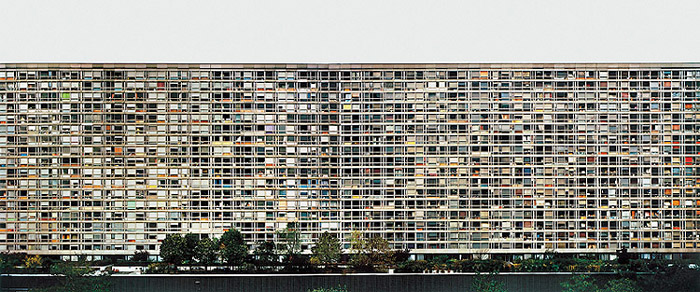
All of the same observations apply here: perfect period costumes, a meticulous recreation of appropriate Christmas foods for 1964, lovingly warmed in chafing dishes atop period cans of Sterno, and a typical conga line dance. And yet Joan appears to have selected the party decorations to match the exact shade of her dress, or vice-versa. Still shots of Mad Men begin to resemble a Gursky photograph: socio-economic realism transformed into a beguiling limited color palette, played out across repeating geometric patterns. This apparent contradiction is surely one of the things about the show that puts off those who don't like it: in this view, Mad Men transforms important depth into attractive but superficial surface. At times, the show reaches for a degree of stylization that goes beyond Antonioni’s cinematic arrangement and Gurksy's formalist photography, and reaches for the painterly: Don Draper in an Edward Hopper painting.

But appearances also tell the truth: In a sequence both comic and disturbing, Lee Jr. forces Roger into an impersonation of Santa Claus, and then photographs him with the men of the agency sitting on his lap. Those images are simply a double exposure of the truth about both men: Roger is indeed a dirty old man (one can easily imagine him saying just so to his beloved “Joanie” in a different context), and Lee is perfectly happy to have his same-sex desires made visible, but sadistically projected onto another—particularly in a way that perverts the traditional figure of authority, the father he loathes and whose shadow he stands in.

Lee Jr. briefly becomes a character from a David Lynch film (we already knew he was a monster from his previous interactions with Sal Romano), arranging his helpless victim into a perverse mise-en-scéne and taking picture after picture, ripping the cover off of each Polaroid with a kind of sexual glee. The truth of the sequence is all on the surface: Lee Garner Jr.'s sadism and psycho-sexual conflicts, his Oedipal issues, Roger as dirty old man—even Christmas itself as an already perverse scenario of sexual dependence.

Everything about the episode insists on this last point, the fundamentally “adult” character of Christmas in capitalist America, from the Roman office orgy to Don's drunken grappling with his secretary. All of them are based on the figure of the “sugar daddy,” the one who provides “gifts” (two fifty dollar bills, the continuing business of Lucky Strike cigarettes) in exchange for sexual acts (quickie on Don's sofa, humiliating Polaroids of yourself in costume). (It doesn’t always work: the SCDP artist Joey attempts to win over Allison with a cartoon of her as Aphrodite, goddess of love, but it doesn’t take.)

The horror of Glen Bishop is that he has always been ahead of the curve, too sexual too early, and he both sadistically defaces Betty's home in revenge for her “infidelity,” while offering Sally Draper in her unspoiled room a “Christmas gift,” whose sexual promise—or menace—is clear (it is the black-and-red lanyard that was attached to his knife, left on her bed). All of these “concealed truths” are completely open, on the surface, self-developing Polaroids. The shallow and formulaic Christmas card that Don leaves for his secretary really is thanking her for all her hard work (in the office, and on the couch), just as the truth of Christmas is on display every year and in the closing credits in the form of a grotesque hit song: “I Saw Mommy Kissing Santa Claus.” (If you like, this is the “work” of the episode, the transformation of the sweet and child-appropriate 1936 song “Christmas Comes But Once a Year” into the sexual and ambiguous 1952 Jimmy Boyd hit.)

Dr. Faye Miller, a specialist in consumer evaluation (an early form of focus groups) who seems both professionally and personally fascinated by Don, offers a differing view: advertising exists, she suggests, in order to resolve the conflict between depth and surface. There is, on the one hand, what people secretly want, their most venal and banal of desires, and there is how they are supposed to behave (civilization and its discontents): depth and appearance. Advertising, according to Dr. Miller, is what mediates between the two, offering a lie that also tells the truth, the deepest desire in the guise of something socially acceptable.

The trick in viewing Mad Men is not to look for the ways in which it fails to address “serious” topics of weighty political importance (the show is trivial, superficial, glamorizes mere consumption, etc.), but instead to seek out the many ways in which the show's superficiality, and the superficiality of its characters, speak to precisely the realist truths its gloss sometimes seems to slide over. This is not direct, didactic and political speech, however—and as a result, it can maintain the fascination and glamorous power of images.

Surfaces that conceal, surfaces that reveal. This double play of the surface appears quite forcefully, and very early on in the episode. When Freddy Rumsen arrives with a new account, he is momentarily distracted from his double dealings (the essence of depth—depth and deception are the same) by a modernist image on the wall, an optical illusion (i.e., cinema, television) that combines depth, a flat screen and the illusion of movement.

“I feel like I'm getting sucked into that thing,” Freddy says, but the feeling he's describing is both an irresistible attraction as well as the falling sensation of vertigo. This is, of course, another Mad Men reference to Hitchcock, but it is also once again nothing but the opening credit sequence. (I have been able to discern two absolute constants in the Mad Men universe: Pete Campbell is always right, and everything about the show can be derived from the opening credits.) The interminable play of three-dimensional spaces that turn out to be flat vector graphics, the creation of depth (falling, falling), ultimately revealed as a blank, flat, unreadable service that nonetheless exerts a magnetic attraction.

I, too, feel like I'm getting sucked into this thing.


Read more

Madmen Yourself ("Why We Love Mad Men")

Thursday, September 3, 2009

posted under , , , , , by Unit for Criticism


A few weeks ago, inspired partly by some columns that the New York Times published on the topic, I decided to write a short essay on Mad Men, the AMC television series about the world of advertising in the early 1960s. Even if you have never watched the show you may be aware that it has a large following among academics (among others). As I wrote in the essay-- originally titled "Madmen Yourself" and which appears in this week's Chronicle of Higher Education--audience enthusiam for the show is itself a remarkable subject:
"By the time the season-three premier was promoted this month, my friends (men and women in their 30s and 40s) had taken to posting Madmenized avatars of themselves on their Facebook pages. ...What had happened to make these politically progressive adults in the last days of their youth identify with characters from their parents' generation?"


(I should add that Mad Men has many committed viewers who came of age in the 1960s including, fortunately for me, the editor at the Chronicle.)

The brief analysis I offered seems to have worked for the readers who have commented on it. And yet I know from having shared the essay prior to its publication that there are different ways of appreciating Mad Men and of thinking about the dialogue it provokes about history and the present day.

I would love to hear more about them.

Oh and neither the New York Times column nor my essay in the Chronicle contains any season-three spoilers.

Lauren Goodlad

Read more

top