Mad World on Kritik: Mad Men Season 4.2
"Potemkinville"
Tuesday, August 3, 2010
posted under
1960s
,
Antonioni
,
cinema
,
Gursky
,
Mad Men
,
Mad World
,
Rushing
by Unit for Criticism

[ The second in the Unit for Criticism's multi-authored series of posts on Season 4 of AMC's Mad Men was published in anticipation of MAD WORLD: Sex, Politics, Style, and the 1960s (Duke University Press.]
"POTEMKINVILLE"
Written by Robert A. Rushing (Associate Director, Unit for Criticism/Italian/Comparative Literature/Cinema Studies)
Like virtually every episode of Mad Men, “Christmas Comes But Once a Year,” which aired this Sunday, is an episode about appearances, usually deceptive ones. The title refers back to a 1936 cartoon of the same name from Fleischer Studios (Superman, Betty Boop, Popeye, etc.) in which Professor Grampy, singing the title song, pretends to be Santa Claus for the children in an orphanage.
This Mad Men episode is anything but a consoling fable for orphans: the increasingly creepy Glen Bishop (played by Matt Weiner’s son Marten) warns Sally Draper that, despite the apparent stability of her new family, changes are coming: “After a while, they'll have another baby.” And later he notes about their equally apparently stable house: “you’ll be moving soon.” Meanwhile Peggy becomes a virgin for the second time with her new boyfriend—yet another example of “something that never happened,” a virtual mantra for Mad Men; Don suggests as much to his secretary, Allison, after having sex with her on his couch (although “next time on Mad Men” suggests that perhaps this storyline isn’t over).
Referring to the chic but sterile decor of the Sterling Cooper Draper Pryce advertising agency, Roger Sterling says that his visitor shouldn't be fooled—“it's really Potemkinville.” Roger is referring to the so-called “Potemkin villages,” towns originally created to impress the Czar, but most memorably used by the Soviets for pure show, propaganda to show off the happy wonders of socialism. In the last post on Mad Men, Lilya Kaganovsky referred to the “missing piece” of SCDP, the absent second story, but this is just as easily represented as a question of surface and depth. SCDP, in this episode, is just a façade.
SCDP’s Potemkin village status returns later in the episode, when the financially strapped agency has to put on a cinematic Madison Avenue Christmas Party for Lee Garner, Jr., the son of the owner of their main client, Lucky Strike cigarettes. “I've seen the movies,” Lee Jr. says, no doubt referring to the infamous Christmas office party in The Apartment (1960). “We need to change [the party's] rating from ‘convalescent home’ to ‘Roman orgy,’” quips Roger. In other words, both economic systems are revealed as essentially hollow: if the Soviets preferred to show unexpected visitors villages filled with happy peasants overflowing with grain, SCDP will offer up instead the glamour of advertising magic fused with cinema, something that they now specialize in after Don's High Noon Glo-Coat commercial (itself a flat prison surface revealed to be an open three-dimensional space). But instead of selling Glo-Coat by way of High Noon, they will sell SCDP by way of Caligula.
Mad Men itself has always done just this: sold itself by way of cinema. Its cinematic references are too numerous to enumerate exhaustively, but as I argue in my chapter in the Mad World volume, it shows a number of debts to Antonioni, the modernist Italian director responsible for L'avventura and Blow-Up. Those debts are thematic, but they are also stylistic, even purely formal: long takes, slow action, an absence of dialogue in key scenes, elaborate framing and positioning of characters for purely visual or geometric effect, and so on.
Mad Men here faces a kind of stylistic dilemma: on the one hand, it has dedicated-- famously--vast resources and energy to an exact and faithful mimesis. That is so much the case that the few trivial mistakes (Bryn Mawr didn't have sororities, so Betty can't have belonged to one) are well-known, the exceptions that prove the rule. Mad Men is invested in realism (perhaps more of the 19th-century variety than of the postwar Italian film sort), and the attendant socio-economic depth that realism wants to reveal behind the façade of customs and trappings. And yet the show's realist impulses constantly run up against its love of style and form. Let us take three shots from this past Sunday’s episode.
 This is a typical shot from the show: a meticulous mise-en-scéne, with period wallpaper, precisely the right clothes, the clutter of half-done homework and half-finished food preparation (carrots, potatoes and, are those turnips?)—no doubt the spices in the spice rack are all in period bottles with the tint labels for 1964. But on a second or third glance, one notices the strange color harmony of the shot, the way that Sally Draper's dress picks up the patterns of the wallpaper, that Carla's apron and dress match the tonal palette of the Draper kitchen. It is their space, but in a way that Mad Men's formalism renders almost uncanny.
Sally's dress does not just pick the geometric squares of the wallpaper; it is also black and red, the colors of Glen Bishop's lanyard, which we see in the episode's opening sequence. “Those are good colors,” Sally announces when she sees it, and now the colors appear on her dress, just as she receives a phone call from Glen. The cosmic formalism of the show is one in which a perfect realism, chaotic and contingent, shows the constant distorting traces of a god—one fond of symbolic color matching.
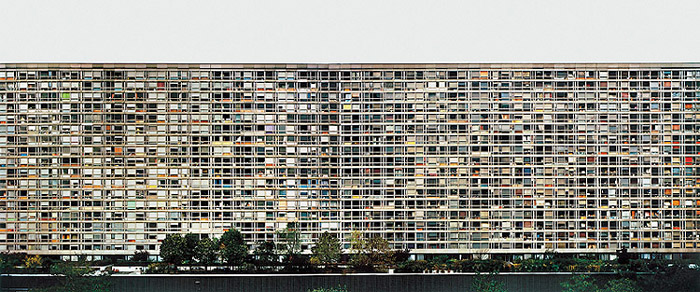
 All of the same observations apply here: perfect period costumes, a meticulous recreation of appropriate Christmas foods for 1964, lovingly warmed in chafing dishes atop period cans of Sterno, and a typical conga line dance. And yet Joan appears to have selected the party decorations to match the exact shade of her dress, or vice-versa. Still shots of Mad Men begin to resemble a Gursky photograph: socio-economic realism transformed into a beguiling limited color palette, played out across repeating geometric patterns. This apparent contradiction is surely one of the things about the show that puts off those who don't like it: in this view, Mad Men transforms important depth into attractive but superficial surface. At times, the show reaches for a degree of stylization that goes beyond Antonioni’s cinematic arrangement and Gurksy's formalist photography, and reaches for the painterly: Don Draper in an Edward Hopper painting.
 But appearances also tell the truth: In a sequence both comic and disturbing, Lee Jr. forces Roger into an impersonation of Santa Claus, and then photographs him with the men of the agency sitting on his lap. Those images are simply a double exposure of the truth about both men: Roger is indeed a dirty old man (one can easily imagine him saying just so to his beloved “Joanie” in a different context), and Lee is perfectly happy to have his same-sex desires made visible, but sadistically projected onto another—particularly in a way that perverts the traditional figure of authority, the father he loathes and whose shadow he stands in.
 Lee Jr. briefly becomes a character from a David Lynch film (we already knew he was a monster from his previous interactions with Sal Romano), arranging his helpless victim into a perverse mise-en-scéne and taking picture after picture, ripping the cover off of each Polaroid with a kind of sexual glee. The truth of the sequence is all on the surface: Lee Garner Jr.'s sadism and psycho-sexual conflicts, his Oedipal issues, Roger as dirty old man—even Christmas itself as an already perverse scenario of sexual dependence.
Everything about the episode insists on this last point, the fundamentally “adult” character of Christmas in capitalist America, from the Roman office orgy to Don's drunken grappling with his secretary. All of them are based on the figure of the “sugar daddy,” the one who provides “gifts” (two fifty dollar bills, the continuing business of Lucky Strike cigarettes) in exchange for sexual acts (quickie on Don's sofa, humiliating Polaroids of yourself in costume). (It doesn’t always work: the SCDP artist Joey attempts to win over Allison with a cartoon of her as Aphrodite, goddess of love, but it doesn’t take.)
The horror of Glen Bishop is that he has always been ahead of the curve, too sexual too early, and he both sadistically defaces Betty's home in revenge for her “infidelity,” while offering Sally Draper in her unspoiled room a “Christmas gift,” whose sexual promise—or menace—is clear (it is the black-and-red lanyard that was attached to his knife, left on her bed). All of these “concealed truths” are completely open, on the surface, self-developing Polaroids. The shallow and formulaic Christmas card that Don leaves for his secretary really is thanking her for all her hard work (in the office, and on the couch), just as the truth of Christmas is on display every year and in the closing credits in the form of a grotesque hit song: “I Saw Mommy Kissing Santa Claus.” (If you like, this is the “work” of the episode, the transformation of the sweet and child-appropriate 1936 song “Christmas Comes But Once a Year” into the sexual and ambiguous 1952 Jimmy Boyd hit.)
Dr. Faye Miller, a specialist in consumer evaluation (an early form of focus groups) who seems both professionally and personally fascinated by Don, offers a differing view: advertising exists, she suggests, in order to resolve the conflict between depth and surface. There is, on the one hand, what people secretly want, their most venal and banal of desires, and there is how they are supposed to behave (civilization and its discontents): depth and appearance. Advertising, according to Dr. Miller, is what mediates between the two, offering a lie that also tells the truth, the deepest desire in the guise of something socially acceptable.
The trick in viewing Mad Men is not to look for the ways in which it fails to address “serious” topics of weighty political importance (the show is trivial, superficial, glamorizes mere consumption, etc.), but instead to seek out the many ways in which the show's superficiality, and the superficiality of its characters, speak to precisely the realist truths its gloss sometimes seems to slide over. This is not direct, didactic and political speech, however—and as a result, it can maintain the fascination and glamorous power of images.
Surfaces that conceal, surfaces that reveal. This double play of the surface appears quite forcefully, and very early on in the episode. When Freddy Rumsen arrives with a new account, he is momentarily distracted from his double dealings (the essence of depth—depth and deception are the same) by a modernist image on the wall, an optical illusion (i.e., cinema, television) that combines depth, a flat screen and the illusion of movement.
 “I feel like I'm getting sucked into that thing,” Freddy says, but the feeling he's describing is both an irresistible attraction as well as the falling sensation of vertigo. This is, of course, another Mad Men reference to Hitchcock, but it is also once again nothing but the opening credit sequence. (I have been able to discern two absolute constants in the Mad Men universe: Pete Campbell is always right, and everything about the show can be derived from the opening credits.) The interminable play of three-dimensional spaces that turn out to be flat vector graphics, the creation of depth (falling, falling), ultimately revealed as a blank, flat, unreadable service that nonetheless exerts a magnetic attraction.
I, too, feel like I'm getting sucked into this thing.

Read more
"POTEMKINVILLE"
Written by Robert A. Rushing (Associate Director, Unit for Criticism/Italian/Comparative Literature/Cinema Studies)
Like virtually every episode of Mad Men, “Christmas Comes But Once a Year,” which aired this Sunday, is an episode about appearances, usually deceptive ones. The title refers back to a 1936 cartoon of the same name from Fleischer Studios (Superman, Betty Boop, Popeye, etc.) in which Professor Grampy, singing the title song, pretends to be Santa Claus for the children in an orphanage.
This Mad Men episode is anything but a consoling fable for orphans: the increasingly creepy Glen Bishop (played by Matt Weiner’s son Marten) warns Sally Draper that, despite the apparent stability of her new family, changes are coming: “After a while, they'll have another baby.” And later he notes about their equally apparently stable house: “you’ll be moving soon.” Meanwhile Peggy becomes a virgin for the second time with her new boyfriend—yet another example of “something that never happened,” a virtual mantra for Mad Men; Don suggests as much to his secretary, Allison, after having sex with her on his couch (although “next time on Mad Men” suggests that perhaps this storyline isn’t over).
Referring to the chic but sterile decor of the Sterling Cooper Draper Pryce advertising agency, Roger Sterling says that his visitor shouldn't be fooled—“it's really Potemkinville.” Roger is referring to the so-called “Potemkin villages,” towns originally created to impress the Czar, but most memorably used by the Soviets for pure show, propaganda to show off the happy wonders of socialism. In the last post on Mad Men, Lilya Kaganovsky referred to the “missing piece” of SCDP, the absent second story, but this is just as easily represented as a question of surface and depth. SCDP, in this episode, is just a façade.
SCDP’s Potemkin village status returns later in the episode, when the financially strapped agency has to put on a cinematic Madison Avenue Christmas Party for Lee Garner, Jr., the son of the owner of their main client, Lucky Strike cigarettes. “I've seen the movies,” Lee Jr. says, no doubt referring to the infamous Christmas office party in The Apartment (1960). “We need to change [the party's] rating from ‘convalescent home’ to ‘Roman orgy,’” quips Roger. In other words, both economic systems are revealed as essentially hollow: if the Soviets preferred to show unexpected visitors villages filled with happy peasants overflowing with grain, SCDP will offer up instead the glamour of advertising magic fused with cinema, something that they now specialize in after Don's High Noon Glo-Coat commercial (itself a flat prison surface revealed to be an open three-dimensional space). But instead of selling Glo-Coat by way of High Noon, they will sell SCDP by way of Caligula.
Mad Men itself has always done just this: sold itself by way of cinema. Its cinematic references are too numerous to enumerate exhaustively, but as I argue in my chapter in the Mad World volume, it shows a number of debts to Antonioni, the modernist Italian director responsible for L'avventura and Blow-Up. Those debts are thematic, but they are also stylistic, even purely formal: long takes, slow action, an absence of dialogue in key scenes, elaborate framing and positioning of characters for purely visual or geometric effect, and so on.
Mad Men here faces a kind of stylistic dilemma: on the one hand, it has dedicated-- famously--vast resources and energy to an exact and faithful mimesis. That is so much the case that the few trivial mistakes (Bryn Mawr didn't have sororities, so Betty can't have belonged to one) are well-known, the exceptions that prove the rule. Mad Men is invested in realism (perhaps more of the 19th-century variety than of the postwar Italian film sort), and the attendant socio-economic depth that realism wants to reveal behind the façade of customs and trappings. And yet the show's realist impulses constantly run up against its love of style and form. Let us take three shots from this past Sunday’s episode.
 This is a typical shot from the show: a meticulous mise-en-scéne, with period wallpaper, precisely the right clothes, the clutter of half-done homework and half-finished food preparation (carrots, potatoes and, are those turnips?)—no doubt the spices in the spice rack are all in period bottles with the tint labels for 1964. But on a second or third glance, one notices the strange color harmony of the shot, the way that Sally Draper's dress picks up the patterns of the wallpaper, that Carla's apron and dress match the tonal palette of the Draper kitchen. It is their space, but in a way that Mad Men's formalism renders almost uncanny.
Sally's dress does not just pick the geometric squares of the wallpaper; it is also black and red, the colors of Glen Bishop's lanyard, which we see in the episode's opening sequence. “Those are good colors,” Sally announces when she sees it, and now the colors appear on her dress, just as she receives a phone call from Glen. The cosmic formalism of the show is one in which a perfect realism, chaotic and contingent, shows the constant distorting traces of a god—one fond of symbolic color matching.
 All of the same observations apply here: perfect period costumes, a meticulous recreation of appropriate Christmas foods for 1964, lovingly warmed in chafing dishes atop period cans of Sterno, and a typical conga line dance. And yet Joan appears to have selected the party decorations to match the exact shade of her dress, or vice-versa. Still shots of Mad Men begin to resemble a Gursky photograph: socio-economic realism transformed into a beguiling limited color palette, played out across repeating geometric patterns. This apparent contradiction is surely one of the things about the show that puts off those who don't like it: in this view, Mad Men transforms important depth into attractive but superficial surface. At times, the show reaches for a degree of stylization that goes beyond Antonioni’s cinematic arrangement and Gurksy's formalist photography, and reaches for the painterly: Don Draper in an Edward Hopper painting.
 But appearances also tell the truth: In a sequence both comic and disturbing, Lee Jr. forces Roger into an impersonation of Santa Claus, and then photographs him with the men of the agency sitting on his lap. Those images are simply a double exposure of the truth about both men: Roger is indeed a dirty old man (one can easily imagine him saying just so to his beloved “Joanie” in a different context), and Lee is perfectly happy to have his same-sex desires made visible, but sadistically projected onto another—particularly in a way that perverts the traditional figure of authority, the father he loathes and whose shadow he stands in.
 Lee Jr. briefly becomes a character from a David Lynch film (we already knew he was a monster from his previous interactions with Sal Romano), arranging his helpless victim into a perverse mise-en-scéne and taking picture after picture, ripping the cover off of each Polaroid with a kind of sexual glee. The truth of the sequence is all on the surface: Lee Garner Jr.'s sadism and psycho-sexual conflicts, his Oedipal issues, Roger as dirty old man—even Christmas itself as an already perverse scenario of sexual dependence.
Everything about the episode insists on this last point, the fundamentally “adult” character of Christmas in capitalist America, from the Roman office orgy to Don's drunken grappling with his secretary. All of them are based on the figure of the “sugar daddy,” the one who provides “gifts” (two fifty dollar bills, the continuing business of Lucky Strike cigarettes) in exchange for sexual acts (quickie on Don's sofa, humiliating Polaroids of yourself in costume). (It doesn’t always work: the SCDP artist Joey attempts to win over Allison with a cartoon of her as Aphrodite, goddess of love, but it doesn’t take.)
The horror of Glen Bishop is that he has always been ahead of the curve, too sexual too early, and he both sadistically defaces Betty's home in revenge for her “infidelity,” while offering Sally Draper in her unspoiled room a “Christmas gift,” whose sexual promise—or menace—is clear (it is the black-and-red lanyard that was attached to his knife, left on her bed). All of these “concealed truths” are completely open, on the surface, self-developing Polaroids. The shallow and formulaic Christmas card that Don leaves for his secretary really is thanking her for all her hard work (in the office, and on the couch), just as the truth of Christmas is on display every year and in the closing credits in the form of a grotesque hit song: “I Saw Mommy Kissing Santa Claus.” (If you like, this is the “work” of the episode, the transformation of the sweet and child-appropriate 1936 song “Christmas Comes But Once a Year” into the sexual and ambiguous 1952 Jimmy Boyd hit.)
Dr. Faye Miller, a specialist in consumer evaluation (an early form of focus groups) who seems both professionally and personally fascinated by Don, offers a differing view: advertising exists, she suggests, in order to resolve the conflict between depth and surface. There is, on the one hand, what people secretly want, their most venal and banal of desires, and there is how they are supposed to behave (civilization and its discontents): depth and appearance. Advertising, according to Dr. Miller, is what mediates between the two, offering a lie that also tells the truth, the deepest desire in the guise of something socially acceptable.
The trick in viewing Mad Men is not to look for the ways in which it fails to address “serious” topics of weighty political importance (the show is trivial, superficial, glamorizes mere consumption, etc.), but instead to seek out the many ways in which the show's superficiality, and the superficiality of its characters, speak to precisely the realist truths its gloss sometimes seems to slide over. This is not direct, didactic and political speech, however—and as a result, it can maintain the fascination and glamorous power of images.
Surfaces that conceal, surfaces that reveal. This double play of the surface appears quite forcefully, and very early on in the episode. When Freddy Rumsen arrives with a new account, he is momentarily distracted from his double dealings (the essence of depth—depth and deception are the same) by a modernist image on the wall, an optical illusion (i.e., cinema, television) that combines depth, a flat screen and the illusion of movement.
 “I feel like I'm getting sucked into that thing,” Freddy says, but the feeling he's describing is both an irresistible attraction as well as the falling sensation of vertigo. This is, of course, another Mad Men reference to Hitchcock, but it is also once again nothing but the opening credit sequence. (I have been able to discern two absolute constants in the Mad Men universe: Pete Campbell is always right, and everything about the show can be derived from the opening credits.) The interminable play of three-dimensional spaces that turn out to be flat vector graphics, the creation of depth (falling, falling), ultimately revealed as a blank, flat, unreadable service that nonetheless exerts a magnetic attraction.
I, too, feel like I'm getting sucked into this thing.

Read more